
A brief overview of CO2 scales for supporting atmospheric monitoring of carbon dioxide (CO2) at remote and urban areas

Abstract
Carbon dioxide (CO2) is a major greenhouse gas that significantly contributes to climate change. Atmospheric CO2 concentrations are closely linked to human activities such as fossil fuel combustion, deforestation, and industrial processes. Precise and consistent atmospheric measurement of CO2 concentrations is crucial for verifying global and national greenhouse gas emissions, particularly in the context of climate change mitigation. Both global and national greenhouse gas initiatives have been launched to enhance atmospheric greenhouse gas monitoring sites, improving the understanding of the impact of climate change mitigation actions. These efforts have led to an increased demand for CO2 reference materials. The National Oceanic and Atmospheric Administration, designated as a Central Calibration Laboratory by the World Meteorological Organization (WMO), maintains and disseminates the WMO CO2 scale (i.e., reference measurement standard) to atmospheric monitoring sites within the WMO Global Atmospheric Watch programme. National metrology institutes including the Korea Research Institute of Standards and Science (KRISS) are developing their own CO2 scale to meet the growing demand for CO2 reference materials. This paper provides a brief overview of the WMO CO2 scale, the activities of the Consultative Committee for Amount of Substance: Metrology in Chemistry and Biology, Gas Analysis Working Group Task Group, and the development and establishment of the KRISS CO2 scale.
Keywords:
Climate Change, Greenhouse Gas, Carbon Dioxide, WMO CO2 Scale, KRISS CO2 Scale1. Introduction
Carbon dioxide (CO2) is one of the major greenhouse gases contributing to greenhouse effects, ultimately leading to climate change. Prior to the 1950s, the link between atmospheric CO2 concentrations and Earth’s temperatures was still under debate, as sporadic and discrete measurements of atmospheric CO2 concentrations lacked the precision and continuity required to support this connection (ACS, 2015). The pioneering work of the Scripps Institution of Oceanography (SIO) produced more precise and long-term measurements of atmospheric CO2 concentrations, revealing distinct seasonal variations (6 μmol mol-1) and annual increases (0.8 μmol mol-1) in atmospheric CO2 concentrations at a remote location (Keeling, 1976). This confirmed earlier findings of seasonal variations and annual increases in atmospheric CO2 concentrations (Keeling, 1960). These small seasonal variations and annual increases are captured through precise and long-term measurements of atmospheric CO2, underpinned by the SIO CO2 scale. Since 1957, the SIO has been monitoring atmospheric CO2 through its CO2 program. In 1958, SIO established its own CO2 scale using a set of gas mixtures (CO2 in nitrogen), which were later replaced by a new CO2 scale using a new set of gas (CO2 in air)(Keeling et al., 1984). The SIO served as Central Calibration Laboratory (CCL) of the Baseline Atmospheric Pollution Monitoring Network of the World Meteorological Organization (WMO) from 1975–1995. In 1995, the role of CCL for CO2 measurement was transferred to the National Oceanic and Atmospheric Administration (NOAA) Climate Monitoring and Diagnostics Laboratory (CMDL; currently Global Monitoring Laboratory (GML)), which distributes the WMO CO2 scale to monitoring sites within the WMO Global Atmospheric Watch (GAW) programme (Keeling et al., 2016). The CO2 scale, as a single reference point, plays a pivotal role in ensuring precise, consistent, and long-term monitoring of atmospheric CO2 concentrations, allowing for the detection of small changes in the concentrations. Recently, the WMO has launched the Global Greenhouse Gas Watch (G3W) to enhance the understanding of greenhouse gas cycles and provide high-quality data to support climate mitigation efforts (WMO, 2024). In Korea, the Ministry of Environment has initiated a national greenhouse gas monitoring program to verify emissions and provide high-quality data to support the national mitigation strategies (Moon, 2024). In order to underpin these global and national efforts, the Korea Research Institute of Standards and Science (KRISS) has been developing its CO2 scale that is compatible with the WMO CO2 scale for precise and consistent atmospheric CO2 measurements.
This short review provides a brief overview of the WMO CO2 scale, the activities of the CCQM GAWG Task Group, and the development of the KRISS CO2 scale.
2. The WMO CO2 Scale
The WMO GAW uses a set of gas mixtures to set up a single reference scale for CO2 and other greenhouse gases (e.g., CH4, N2O, and SF6). The designated CCL, NOAA GML, maintains and disseminates the scale to all monitoring sites within the WMO GAW network. All CO2 measurement results within the network are traceable to the WMO CO2 scale instead of the international system of units (SI). Brewer et al. (2018) have discussed in more detail the differences between SI and scale traceability. The WMO CO2 scale includes gas mixtures at three levels, with each level consisting of a set of gas mixtures (Fig. 1). NOAA GML constructed its own manometer to measure the amount fraction (i.e., mole fraction) of CO2 (in air) in gas mixtures at the primary level by directly measuring CO2 and air separately. The manometric measurement procedure is a practical realization of the definition of the mole using the equations of the state for gases recommended by metrology communities (BIPM, 2019). Detailed descriptions of the manometer and its measurement procedure, including uncertainty estimation, can be found in other studies (Hall et al., 2021; Zhao and Tans, 2006; Zhao et al., 1997). The gas mixtures at the primary level value-assigned by the manometer are used to define the scale through orthogonal distance linear regression between assigned values and the responses from an optical analytical instrument. These values are then are transferred to gas mixtures at the secondary level by comparing against those at the primary level, and the values from gas mixtures at the secondary level are transferred to those at the tertiary level. NOAA GML monitors the stability (or drift) of gas mixtures at each level periodically (weekly, monthly or yearly), as even small drifts in the gas mixtures obscures small changes in atmospheric CO2 concentrations. The CO2 scale is revised when significant drifts at the primary level are found (Hall et al., 2021). The current WMO CO2 scale is named WMO-CO2-X2019 (where X denotes amount fraction and 2019 denotes the year in which the assigned values were adopted), which replaced WMO-CO2-X2007. NOAA GML uses spectroscopic analyzers to define the scale and transfer it down to lower levels (e.g., secondary and tertiary). It is crucial to account for differences in both the matrix (or balance gas) and CO2 isotope ratios of gas mixtures when establishing and transferring the scale using spectroscopic analyzers (e.g., NDIR or CRDS) to minimize biases in CO2 measurements. Significant deviations from the natural variability of air composition (e.g., mainly, N2, O2, and Ar) in the matrix can introduce biases in CO2 measurements due to pressure-broaden effects (Nara et al., 2012). To reduce such biases, NOAA GML uses dried natural air collected at a remote site and then spikes pure CO2 to adjust amount fractions up to 800 μmol mol-1. Unlike gas chromatography, which measures total CO2, spectroscopic analyzers measure the most abundant isotopologue (i.e., 16O12C16O) or the three most abundant CO2 isotopologues (i.e., 16O12C16O, 16O13C16O, and 16O12C18O) out of twelve isotopologues. Therefore, to establish and transfer the scale, the CO2 isotope ratios (i.e., δ(13C) and δ(18O)) in the gas mixtures must be known, along with the total CO2 amount fractions (Tans et al., 2017). Detailed information on how to calculate the abundances of isotopologues using total CO2 concentration and isotope ratios is available in Tans et al. (2017). As a Designated Institute (DI) of the WMO, NOAA has participated in an international comparison (CCQM-K120a) organized by the Consultative Committee for Amount of Substance: Metrology in Chemistry and Biology (CCQM) and coordinated by the BIPM headquarters to evaluate the consistency comparing to primary standard gas mixtures prepared by National Metrology Institutes (NMIs)(Flores et al., 2019).
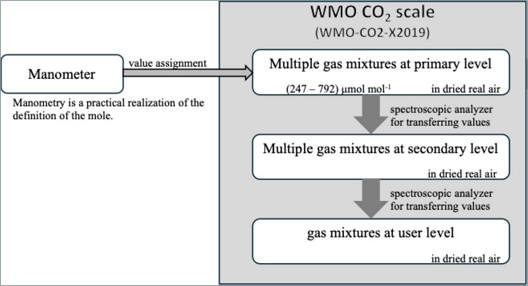
WMO CO2 scale
3. Activities in CCQM Gas Analysis Working Group
The Gas Analysis Working Group (GAWG) is one of the technical working groups under the CCQM, responsible for conducting international comparisons and evaluating and benchmarking the metrological competences of NMIs/DIs in relation to standards and measurement capabilities for gas composition. The CCQM-GAWG, in collaboration with WMO GAW community, has provided a review of advancements in the production of reference materials and measurement techniques of three major greenhouse gases (CO2, CH4 and N2O) as well as their isotopic composition for source apportionment (Brewer et al., 2019). The CCQM-GAWG Task Group on greenhouse gas scale comparisons, consisting of experts from both NMIs and atmospheric science communities, has been developing procedures for establishing and maintaining a CO2 scale, writing a comparison protocol for demonstrating the relationships between different scales (including the WMO CO2 scale), and formulating data management strategies to ensure long-term data integrity and facilitate unambiguous retroactive scale revisions (BIPM, 2025). The BIPM headquarters will coordinate an international key comparison (BIPM.QM-K5) to establish the relationships between different scales and monitor any deviation from the relationships. All results, including the scale relationships, will be stored and made available for converting between scales (e.g., from a NMI CO2 scale to the WMO CO2 scale vice versa).
4. The KRISS CO2 scale
The Gas Metrology Group in KRISS has been developing the KRISS CO2 scale to improve the accessibility of CO2 reference materials that are compatible with the WMO CO2 scale (maintained by NOAA) in response to the global and national greenhouse gas initiatives (i.e., WMO Global Greenhouse Gas Watch and Korea National Greenhouse Gas Monitoring program). Fig. 2 shows a diagram of the KRISS CO2 scale. As mentioned in the previous section, it is important to carefully consider the matrix and CO2 isotope ratios of gas mixtures when establishing and disseminating the CO2 scale to reduce biases in atmospheric CO2 measurements. To match the matrix, the gravimetry gas standards are prepared in synthetic air using gravimetry so that the compositions of three major air components (i.e., N2, O2 and Ar) are close to those in real atmospheric air within a certain range. Gravimetry is a practical realization of the definition of the mole recommended by metrology communities (BIPM, 2019). The gas mixtures in the KRISS CO2 scale are prepared by spiking pure CO2 into a dried real atmospheric air (i.e., H2O amount fraction less than 1 μmol/mol) as the matrix, instead of synthetic air. Regarding CO2 isotope ratios, pure CO2 with its isotope ratios close to those of atmospheric air (i.e., δ(13C) ≈ -8.5 ‰ and δ(18O)) ≈ 0 ‰) at remote areas is used for all gas mixtures, including the gravimetry gas standards. Thus, the CO2 isotope ratios are expected to be consistent or only slightly different for all gas mixtures, results in little bias in the atmospheric CO2 amount fraction measurements. To establish the KRISS CO2 scale, the values (i.e., CO2 amount fractions) and uncertainties of gas mixtures at the primary level are assigned by analyzing those against the gravimetry gas standards. These values are then transferred to gas mixtures at the secondary level, and from those at the secondary level to those at the tertiary level by analyzing against gas mixtures at the respective higher level. KRISS plans to participate in the international key comparison (BIPM.QM-K5) to evaluate the comparability of the KRISS CO2 scale with other CO2 scales, including the WMO and NMI CO2 scales. KRISS is also establishing its own isotope ratio gas standards to underpin the isotope ratio measurements of pure and atmospheric CO2. KRISS is thus participating in an international comparison (CCQM-P239) to evaluate the comparability of the KRISS atmospheric CO2 isotope ratio standards. Additionally, KRISS is developing an air purification system to produce scrubbed dry atmospheric air, in which three major greenhouse gases (i.e., CO2, CH4, and N2O) are less than 10 nmol mol-1 and H2O is less than 1 μmol mol-1. The scrubbed dry atmospheric air can be used as a matrix gas for establishing and maintaining the CO2 scale or as zero-air for evaluating the performance of greenhouse gas analyzers. KRISS also plans to establish its CH4 scale using the similar approach employed for the KRISS CO2 scale.
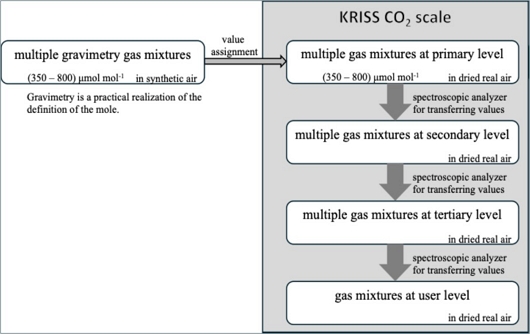
KRISS CO2 scale
5. Conclusion
Global and national greenhouse gas initiatives have been launched to enhance the infrastructure of atmospheric monitoring of greenhouse gases, aiming to verify greenhouse gas emissions and assess the effectiveness of climate change implementation strategies toward carbon neutrality. To achieve the goals of these global and national initiatives, precise and stable gas reference materials are essential for ensuring reliable and comparable greenhouse gas measurements across geographical locations, whether on global, regional, or local scale. The ongoing development of the KRISS CO2 scale, along with other NMIs CO2 scales, is a significant step in improving the accessibility of gas reference materials for the precise and long-term monitoring of atmospheric CO2 concentrations. KRISS is also developing gas standards for measuring CO2 isotope ratios in both pure and atmospheric CO2 to support source apportionment. Furthermore, KRISS will participate in CCQM comparisons to assess the comparability of its gas standards for both CO2 scale (BIPM.QM-K5) and isotope ratios (BIPM.QM-K3 and BIPM.QM-K4). As KRISS continues to advance its metrological capabilities, including the development of an air purification system and the establishment of KRISS CH4 scale and isotope ratios, the KRISS activities, along with other NMIs/DIs activities, are expected to play a vital role in ensuring the integrity and consistency of atmospheric greenhouse gas measurements. Ultimately, these efforts will support global and national efforts of climate change mitigation initiatives.
Acknowledgments
This study was conducted as a part of the Establishment of Measurement Standards in Gas Metrology at the Korea Research Institute of Standards and Science (grant no. KRISS-2025-GP2025-0004-09).
References
- ACS. 2015. The Keeling curve: A national historic chemical landmark. Washington: American Chemical Society. https://www.acs.org/content/dam/acsorg/education/whatischemistry/landmarks/keeling-curve/2015-keeling-curve-landmark-booklet.pdf
- BIPM. 2019. The International System of Units (SI), 9th edn. Appendix 2 Mise en pratique for the definition of the mole. BIPM (Bureau International des Poids et Mesures). https://www.bipm.org/documents/20126/41489679/SI-App2-mole.pdf/be4dea74-a526-e49b-f497-11b393665401?version=1.6&t=1637238198610&download=true, .
- BIPM. 2025. CCQM-GAWG task group on GHG scale comparisons (CCQM-GAWG-TG-GHG). [accessed 2025 Mar 24]. https://www.bipm.org/en/committees/cc/ccqm/wg/CCQM-GAWG-TG-GHG, .
-
Brewer PJ, Brown RJC, Tarasova OA, Hall B, Rhoderick GC, Wielgosz RI. 2018. SI traceability and scales for underpinning atmospheric monitoring of greenhouse gases. Metrologia 55(5): S174-S181.
[https://doi.org/10.1088/1681-7575/aad830]

-
Brewer PJ, Kim JS, Lee S, Tarasova OA, Viallon J, Flores E, Wielgosz RI, Shimosaka T, Assonov S, Allison CE, et al. 2019. Advances in reference materials and measurement techniques for greenhouse gas atmospheric observations. Metrologia 56(3).
[https://doi.org/10.1088/1681-7575/ab1506]
-
Flores E, Viallon J, Choteau T, Moussay P, Idrees F, Wielgosz RI, Lee J, Zalewska E, Nieuwenkamp G, Veen AVD, et al. 2019. CCQM-K120 (carbon dioxide at background and urban level). Metrologia 56(1): 1-181.
[https://doi.org/10.1088/0026-1394/56/1A/08001]
-
Hall BD, Crotwell AM, Kitzis DR, Mefford T, Miller BR, Schibig MF, Tans PP. 2021. Revision of the World Meteorological Organization Global Atmosphere Watch (WMO/GAW) CO2 calibration scale. Atmos Meas Tech 14(4): 3015-3032.
[https://doi.org/10.5194/amt-14-3015-2021]
-
Keeling CD. 1960. The concentration and isotopic abundances of carbon dioxide in the atmosphere. Tellus XII(2): 121-241.
[https://doi.org/10.1111/j.2153-3490.1960.tb01300.x]
-
Keeling CD. 1976. Atmospheric carbon dioxide variations at Mauna Loa Observatory, Hawaii. Tellus XXVIII(6): 538-551.
[https://doi.org/10.3402/tellusa.v28i6.11322]
- Keeling CD, Guenther PR, Jones MA. 1984. Scripps reference gas calibrating system for carbon dioxide in air standards: Revision of 1983. A report prepared for the environmental monitoring program of the world meteorological organization. La Jolla: Scripps Institute of Oceanography. https://scrippsco2.ucsd.edu/assets/publications/keeling_scripps_ref_gas_calibrating_revision_of_1983_report_1984.pdf, .
- Keeling RF, Guenther PR, Walker S, Moss D. 2016. Scripps reference gas calibrating system for carbon dioxide-in- nitrogen and carbon dioxide-in-air standards: Revision of 2012. La Jolla: Scripps Institute of Oceanography. https://scrippsco2.ucsd.edu/assets/publications/manometry_report_scripps_ref_gas_calibration_revision_of_2012_pub_2016.pdf, .
- Moon KJ. 2024. Urban greenhouse gas monitoring network in Korea: Current status and future prospects. Proceedings of the Workshop of CCQM-Gas Analysis Working Group; 2024 Oct 23~Oct 24; KRISS. Daejeon, Korea.
-
Nara H, Tanimoto H, Tohjima Y, Mukai H, Nojiri Y, Katsumata K, Rella CW. 2012. Effect of air composition (N2, O2, Ar, and H2O) on CO2 and ch4 measurement by wavelength-scanned cavity ring-down spectroscopy: Calibration and measurement strategy. Atmos Meas Tech 5(11): 2689-2701.
[https://doi.org/10.5194/amt-5-2689-2012]
-
Tans PP, Crotwell AM, Thoning KW. 2017. Abundances of isotopologues and calibration of CO2 greenhouse gas measurements. Atmos Meas Tech 10(7): 2669-2685.
[https://doi.org/10.5194/amt-10-2669-2017]
- WMO. 2024. Global Greenhouse Gas Watch (G3W). [accessed 2025 Mar 24]. https://g3w.wmo.int/site/global-greenhouse-gas-watch-g3w, .
-
Zhao CL, Tans PP. 2006. Estimating uncertainty of the WMO mole fraction scale for carbon dioxide in air. J Geophys Res D Atmos 111(8).
[https://doi.org/10.1029/2005JD006003]
-
Zhao CL, Tans PP, Thoning KW. 1997. A high precision manometric system for absolute calibrations of CO2 in dry air. J Geophys Res D Atmos 102(5): 5885-5894.
[https://doi.org/10.1029/96JD03764]