
Spatial distribution characteristics of building sector carbon emissions in Yongin City: Applying GIS spatial analysis methods

Abstract
This study analyzes the spatial distribution characteristics of carbon emissions from the building sector of Yongin City using geographic information system (GIS) spatial analysis at a micro-spatial scale and derives implications for carbon reduction. To examine the spatial patterns of building-sector carbon emissions, hotspot and local indicators of spatial association (LISA) analyses were conducted. The results show that clusters with high carbon emissions are concentrated in newly developed urban areas, namely Jukjeon and Pungdeokcheon in the Suji District, and Bojeong, Yeongdeok, and Dongbaek in the Giheung District. The implications of carbon reduction in Yongin City are as follows. First, achieving carbon neutrality requires the establishment of a comprehensive greenhouse gas reduction plan that incorporates microlevel spatial units within the building sector. Second, urban spatial planning strategies that reflect the characteristics of energy use and carbon emissions from buildings should be developed to reduce these emissions effectively. Third, it is necessary to designate spatially based carbon management zones centered on the hotspots and High-Hhgh cluster areas identified in this study. This study contributes to the literature by providing practical implications for carbon reduction through a microscale spatial analysis of building-sector carbon emissions in Yongin City.
Keywords:
GIS Spatial Analysis, Carbon Emissions, Spatial Distribution Characteristics, Hotspot Analysis, Yongin City1. Introduction
In recent years, extreme climate anomalies triggered by global climate change have placed the international community in a state of crisis across multiple domains, including society, environment, and economy. The Intergovernmental Panel on Climate Change (IPCC) reported that the global average temperature increased by 1.09°C between 2011 and 2020 compared to pre-industrial levels, highlighting the worsening trend of global warming (IPCC, 2023). Countries worldwide are experiencing substantial economic losses and human casualties caused by abnormal weather events, such as droughts, floods, typhoons, heat waves, and heavy snowfall. In response, the international community has strengthened its national policy support to set and implement carbon reduction targets, striving to achieve carbon neutrality (Net Zero) (Park et al., 2024). As part of these efforts, global initiatives led by the IPCC have recommended reducing CO2 emissions by more than 45% relative to 2010 levels by 2030, with the ultimate goal of achieving Net Zero by 2050 (Allen et al., 2018).
South Korea has also seen its global responsibilities and obligations increase through international climate agreements, including the 2015 Paris Agreement (Hong, 2024). However, the country continues to rely heavily on emissions-intensive industrial structures, and the share of renewable energy remains at approximately one-seventh of the OECD average. Furthermore, with Korea’s emissions peaking in 2018, the time available to reach the 2050 Net Zero target is considerably shorter than that of other major climate agreement countries (Kim and Son 2019).
In October 2021, the Korean government announced its plan to raise the 2030 Nationally Determined Contribution (NDC), committing to a 40% reduction in greenhouse gas emissions compared with 2018 levels. To achieve this target, the government established and released the Carbon Neutrality and Green Growth Basic Plan in March 2023 pursuant to Article 10 of the Framework Act on Carbon Neutrality and Green Growth (Kang et al., 2024). As Korea moves toward fulfilling its 2030 NDC goals, the formulation of concrete implementation measures and emission-reduction pathways has become increasingly necessary. Accordingly, the Ministry of Trade, Industry, and Energy (MOTIE) increased its 2024 energy sector budget by approximately 532.9 billion KRW compared to the previous year.
Carbon emissions from the energy sector are commonly categorized into buildings, transportation, industry, power generation, and other sectors. According to greenhouse gas emissions data released by the Ministry of Environment for 2022, the industrial sector accounted for 37.6% of the emissions, followed by the power generation sector (32.7%), transportation (14.9%), and buildings (7.4%). For the building sector specifically, emissions must decrease from approximately 52.1 million tons (2018 baseline) to about 35.0 million tons by 2030—a 32.8% reduction—and ultimately to around 6.2 million tons by 2050, equivalent to an 88.8% reduction (Shin & Choi 2022).
This study constructs GIS spatial datasets of carbon emissions from electricity and gas use in Yongin City for the years 2013 and 2023 and analyzes the spatial distribution characteristics of building sector carbon emissions to derive policy implications. Electricity and gas were selected because they account for the vast majority of energy consumption in Yongin City—electricity at 77.1% and gas at 21.5%—while data limitations exist for other energy sources, such as district heating, which accounts for only 1.4% of the total energy use in the city.
2. Review of prior research
Recent studies on carbon emissions in the building sector can be broadly categorized into domestic research and international research. Domestic research first includes Kim et al. (2013), who analyzed building sector energy consumption using national energy survey data to calculate greenhouse gas emissions and identify spatial distribution patterns by building use, business type, energy source, and year of construction. Kim (2015) utilized building datasets from the Seoul metropolitan area to develop a visualization–analysis–simulation model based on spatial analysis data. By examining the attribute information embedded in building sector datasets, this study proposes applicable policy directions within the national land and urban planning domains.
Shin and Choi (2022) examined residential and non-residential buildings using energy consumption data provided by “Green Together,” identifying emission characteristics from 2018 to 2021. Yeo and Yoo (2023) conducted a spatial distribution analysis of building-sector carbon emissions in Suwon City from 2012 to 2021 and proposed policy measures to achieve carbon neutrality. Park et al. (2023) analyzed government-level carbon reduction targets under two scenarios (innovation and safety) depending on the retention of thermal power generation, while Yeo (2024) assessed the spatial distribution of carbon emissions by land-use type in Anyang City and derived policy implications.
International studies have also provided valuable insights. Ma and Cheng (2016) developed a GIS analytical framework that estimated city-scale building energy consumption using optimized algorithms for processing spatial information. Although this framework effectively analyzed multi-unit housing energy use, it paid relatively limited attention to carbon emissions estimation. Jones et al. (2019) constructed a simulation-based model to predict building energy use and emissions, and proposed technological and policy improvements to enhance energy efficiency. Müller et al. (2020) used Life Cycle Assessment (LCA) software and geospatial databases to measure carbon emissions across all phases of a building's life cycle, from construction to demolition, and proposed reduction strategies.
Recent research trends have been evolving toward the integration of diverse analytical methodologies centered on GIS to predict and manage carbon emissions. In particular, there has been active convergence with machine learning, Rahmati et al. (2024) proposed a GIS-based model for reducing energy consumption and carbon emissions that incorporates spatial accessibility. The findings indicate that improving service accessibility within urban areas can lead to a reduction in travel demand and an increase in energy efficiency, thereby generating carbon emission reduction effects. In addition, Gao et al. (2026) introduced an integrated carbon emission estimation model combining LCA, BIM, and GIS. thereby introducing the concept of net carbon emissions. This approach contributes to the establishment of an integrated carbon management system beyond conventional fragmented analyses.
In summary, prior research on building-sector carbon emissions has largely focused on establishing analytical systems, estimating emissions at the building level, and developing new methodological approaches. However, studies that analyze carbon emissions at the microscale (specifically at the parcel level) and present spatial distribution patterns for local governments remain limited. Moreover, research on concrete strategies to achieve carbon neutrality at the local government level remains insufficient. Against this backdrop, this study conducts a spatial analysis of carbon emissions in the building sector at a micro-level, using individual parcels as the unit of analysis in Yongin City.
To this end, spatial analysis datasets were constructed for the years 2013 and 2023, and GIS-based spatial analysis was employed to examine the spatial distribution characteristics of carbon emissions and to derive policy implications for carbon reduction. In this context, parcel-level micro spatial analysis goes beyond merely increasing the precision of analytical units in building-sector carbon emission studies; it enables a reinterpretation of the structural relationship between urban space and energy consumption (Rahmati et al., 2024). Therefore, the application of parcel-level spatial analysis is expected to expand further in future carbon-neutral urban planning and policymaking.
3. Research methods and data
3.1. Research procedures and data
This study comprised a three-step research process. First, to construct the GIS spatial analysis dataset used to examine the spatial patterns of carbon emissions in the building sector of Yongin City, energy consumption data (electricity and gas) for 2013 and 2023 were collected from the open building data system provided by the Ministry of Land, Infrastructure, and Transport (http://open.eais.go.kr). In addition, parcel-level spatial data and the 2023 Officially Announced Individual Land Price (shape format) were obtained from the Digital Twin National Platform (http://www.vworld.kr). The spatial data were then combined with the energy consumption attributes through spatial join operations to construct a GIS spatial analysis database.
Second, to calculate the building sector carbon emissions in Yongin City, this study adopted the GHG emissions estimation methodology provided in the IPCC Guidelines for National Greenhouse Gas Inventories (IPCC, 2023). Fossil fuel (gas) consumption was converted into CO2 emissions using the corresponding IPCC emission factors, whereas electricity consumption was converted using the nationally approved electricity emission factor for the energy sector (2021). Based on these conversion coefficients, carbon emissions associated with electricity and gas use were calculated for each parcel unit in Yongin City (Jung, Cho, et al., 2021; Yeo and Yoo, 2023; Yoo et al., 2019).
Third, to analyze the spatial distribution characteristics of carbon emissions, several GIS spatial analytical techniques were employed, including spatial autocorrelation analysis, Local Indicators of Spatial Association (LISA), and hotspot analysis. By interpreting these spatial distribution patterns, this study derives the spatial characteristics of greenhouse gas emissions in Yongin City and provides implications for carbon reduction. The data construction procedure for the spatial analysis was as follows: Spatial data (parcel-level land price information) and attribute data (monthly electricity and gas consumption) were integrated using spatial join operations to generate a base dataset for analysis.
To enable a join based on shared attribute information between the two datasets, a new PNU (Parcel Numbering Unit) code was generated for the gas and electricity energy datasets by utilizing the following attributes: municipal (si/gun/gu) code, legal dong code, land category code, and lot number. This newly constructed PNU code was then used to perform a spatial join with the official land price dataset (individual officially assessed land price data), resulting in an integrated dataset. For analytical consistency, missing values in energy consumption were treated as zero (“0”). In addition, monthly energy consumption values were aggregated to derive annual consumption for a single year. The use of spatial join techniques is particularly important because linking energy consumption attributes to parcel-level spatial units enables microscale spatial analysis, offering a much higher resolution than analyses conducted at the administrative district (dong) level.
The spatial dataset for the building sector energy consumption was constructed using the most recent parcel-level land price data from the Digital Twin National Platform (V-WORLD). Specifically, the 2023 Officially Announced Individual Land Price dataset (3.6 GB, SHP file format) was used. In addition, attribute files containing electricity and gas consumption data for buildings, released through the Building Data Open System and representing the most updated 2023 dataset (1.4 GB / 380 MB, TXT file format), were extracted for the entirety of Yongin City and used as foundational data for the spatial analysis. The selection of 2013 and 2023 for spatial and attribute data is based on the following rationale. First, recently established datasets that can serve as foundational data for spatial analysis of carbon emissions across the entirety of Yongin City were utilized. Second, to enable a comparative analysis of changes in carbon emissions over a ten-year period, datasets from 2013 and 2023 were constructed as the baseline data.
3.2. Research methods
This study employs Global Moran’s I, one of the most widely used techniques for measuring spatial autocorrelation. Global Moran’s I assesses whether the spatial distribution of a particular phenomenon exhibits a systematic pattern or occurs randomly. It is particularly useful for determining whether spatial patterns across the study area tend to form clusters or reflect random distributions (Yeo and Yoo, 2023). A Global Moran’s I value close to +1 indicates a strong positive spatial autocorrelation, meaning that similar values are spatially clustered. Conversely, values close to –1 indicate negative spatial autocorrelation, suggesting that dissimilar values are located near one another (Lim and Park, 2017). The formula for calculating Global Moran’s I is presented in Eq. (1).
| (1) |
Here, I = global Moran’s I, N = number of observations, Xi, Xj = variable values at i and j, = mean of variable values, ωij = weight matrix values between i and j.
In cases where the spatial units are excessively large or the spatial structure is unstable, the validity of statistical inference and spatial statistical models based on Global Moran’s I may be compromised (Park et al., 2021). To minimize such limitations, Local Indicators of Spatial Association (LISA) have been proposed as an alternative method for examining spatial autocorrelation at a local level (Anselin, 1995). LISA analysis applies the concept of Local Moran’s I to evaluate the degree of similarity between the value observed in a specific location and the weighted average of values in its neighboring areas. When a local value is similar to the weighted mean of adjacent areas, the result indicates positive local spatial autocorrelation. Conversely, when the local value sharply contrasts with the values of neighboring areas, the result reflects negative local spatial autocorrelation. The formula for calculating the Local Moran’s I statistic is presented in Eq. (2). In Eq. (2), the term is computed according to the formula shown in Eq. (3).
| (2) |
Here Ii = local Moran’s I, xi = i variable value in the region, ωij = mean value of the variable, ωij = spatial weight matrix between i and j.
| (3) |
The LISA analysis classifies local spatial autocorrelation patterns into four distinct categories based on the application of Local Moran’s I (Choi et al., 2018). First, the High–High (HH) cluster indicates that the value of the target region is higher than the average and that neighboring regions also exhibit high values. Second, the Low–Low (LL) cluster is characterized by low values in both the target region and its surrounding areas. Third, the High–Low (HL) outlier type occurs when the target region has a high value, while adjacent regions show low values. Fourth, the Low–High (LH) outlier type represents a case in which the target region has a low value but is surrounded by areas with high values. In this classification, the LL type represents clusters where both the focal region and its neighbors have low carbon emissions, indicating areas with collectively low emission levels. Conversely, regions classified as HH are interpreted as clusters of high carbon emissions, where elevated emission values spatially converge (Yeo and Lee 2023).
4. Research results
4.1. Result of cluster and outlier analysis
This study analyzed the cluster–outlier characteristics of building-sector carbon emissions in Yongin City by applying the LISA method. In this analysis, the calculated distances were standardized geometric distances, and a row-standardized spatial weight matrix was used to identify spatially formed cluster–outlier patterns. With a significance level of p = 0.01, similar Z-score values are expressed as high-high (HH) clusters when high Z scores are surrounded by similarly high values and low-low (LL) clusters when low Z scores are surrounded by low values. Conversely, spatial units with contrasting characteristics are identified as high-low (HL) clusters when high Z scores are surrounded by low-value neighbors and low-high (LH) clusters when low local Z scores are adjacent to high-value areas.
LISA results for Yongin City showed that HH clusters, areas with high carbon emission concentrations, expanded in certain locations from 2013 to 2023, with new HH clusters emerging in Mohyeon Eup, Cheoin-gu. Across both years, common HH clusters were found in parts of Suji-gu (Dongcheon-dong and Sanghyeon-dong), Giheung-gu (Bora-dong and Sanggal-dong), and Cheoin-gu (Pogok-eup, Yeokbuk-dong, Samga-dong, and Gimnyangjang-dong), indicating persistent spatial concentrations of high carbon emissions (Fig. 1).
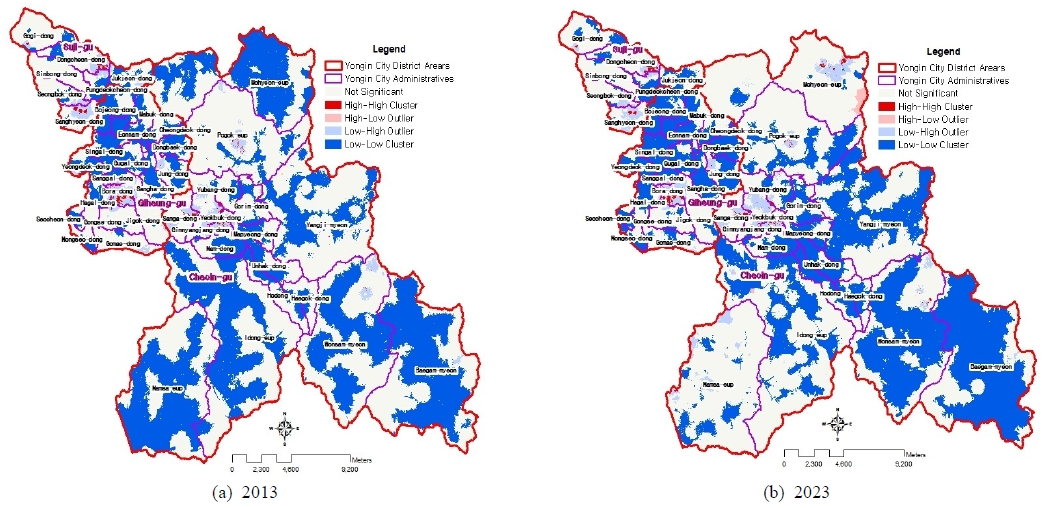
Result of cluster and outlier analysis
Especially notable is the strong HH clustering in major new town development areas formed after the 2000s, such as Jukjeon and Pungdeokcheon in Suji-gu and Bojeong, Yeongdeok, and the Dongbaek district in Giheung-gu, where high-rise residential complexes and large-scale commercial facilities are densely located. In contrast, most parts of Cheoin-gu, representing older urban districts, formed LL clusters in 2013 and 2023, indicating persistently low carbon emissions.
Meanwhile, HL and LH outlier clusters appeared irregularly throughout Suji-gu, Giheung-gu, and Cheoin-gu, especially near HH cluster areas such as Bora-dong and Singal-dong in Giheung-gu. These outlier locations represent parcels in which the emission levels deviate sharply from the surrounding values. The presence of LH outliers near HH clusters can be attributed to the boundary areas of large new towns, such as Jukjeon, and the distribution of large-scale apartment complexes adjacent to high-emission zones.
A comparison of the spatial distribution between 2013 and 2023 reveals that the HH clusters in Suji-gu (Sanghyeon-dong and Dongcheon-dong) contract slightly over time, whereas the HH cluster in Mohyeon-eup (Cheoin-gu) expanded significantly. LH outliers, representing unusual local–neighbor contrasts, were consistently observed around the HH cluster zones in both years (Fig. 1). This pattern suggests that transitional boundary areas near high-density residential developments exhibit distinct emissions characteristics.
Overall, the results indicated that parcels with high building-sector carbon emissions were strongly clustered in specific districts, particularly in Suji-gu and Giheung-gu, where high-rise residential complexes and commercial buildings were concentrated. Moreover, carbon emissions associated with electricity and gas consumption were found to be relatively high in particular neighborhoods, including Sanghyeon-dong and Dongcheon-dong (Suji-gu) and Bora-dong and Sanggal-dong (Giheung-gu).
4.2. Result of hotspot analysis
Here, the spatial clustering patterns of building-sector carbon emissions in Yongin City for 2013 and 2023 were identified using the Getis–Ord Gi* statistic. A hotspot analysis was conducted to clearly visualize and delineate areas exhibiting significant spatial concentrations. When the Gi* statistic yields positive values, the corresponding locations are interpreted as hotspots, indicating spatial clusters of relatively high carbon emissions (Yeo and Yoo, 2023). Conversely, negative Gi* values represent cold spots, indicating clusters with relatively low emissions. When the Gi* statistic approaches zero, the spatial unit does not differ significantly from its surrounding areas, indicating that no spatial clustering of high or low values is present.
A hotspot analysis of carbon emissions in Yongin City was performed using a distance-based threshold method. The Z-test was used to evaluate the statistical significance of the results. Statistically significant hotspots and cold spots were identified through this verification process. Furthermore, to enhance the visual representation of the spatial extent of these clusters, Inverse Distance Weighting (IDW) interpolation was employed to generate continuous spatial surfaces that depicted the distribution patterns of carbon emissions (Lee and Yeo, 2021). Fig. 2 presents the visualization results of the hotspot analysis, showing the Getis–Ord Gi* Z scores for greenhouse gas emissions derived from electricity and gas use in the building sector of Yongin City for 2013 and 2023.
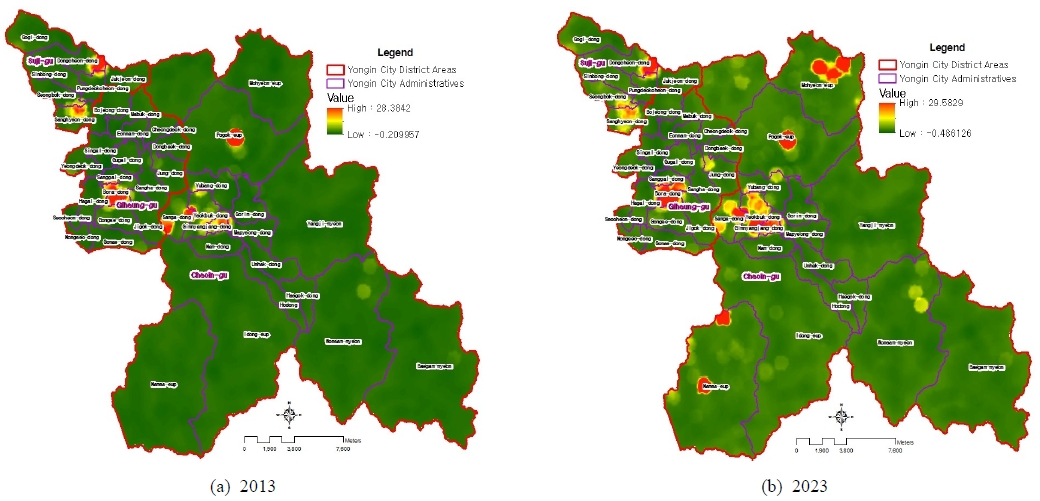
Result of hotspot analysis
A hotspot analysis of carbon emissions in Yongin City revealed five distinct hotspot areas in 2013: Dongcheon-dong, Sanghyeon-dong, Pogok-eup, Samga-dong, and Bora-dong. In particular, strong hotspot concentrations emerged in Suji-gu (Dongcheon-dong and Sanghyeon-dong) and Cheoin-gu (Pogok-eup and Samga-dong), indicating areas with relatively high carbon emissions (Fig. 2). The spatial patterns observed through hotspot analysis closely aligned with the results of the earlier LISA cluster–outlier analysis, confirming that areas classified as hotspots corresponded to locations with comparatively high greenhouse gas emissions.
The temporal changes in hotspot distribution between 2013 and 2023 show the following trends: While Sanghyeon-dong in Suji-gu exhibited weakening hotspot characteristics by 2023, hotspot patterns in Samga-dong, Yeokbuk-dong, and Gimnyangjang-dong (Cheoin-gu) intensified compared to 2013. Notably, Mohyeon-eup and Namsa-eup in Cheoin-gu experienced a significant expansion in hotspot areas in 2023 relative to 2013. This suggests that the carbon emissions in these regions have increased spatially over the past decade.
The expansion of hotspot areas in Mohyeon-eup and Namsa-eup may be attributed to several factors, including the growth of apartment complexes and residential developments around Wangsanni in Mohyeon-eup, as well as major urban development projects in Namsa-eup, such as the Agok District, leading to increases in industrial and logistics facilities and mixed-use residential–commercial developments. These developments are likely to have contributed to the increase in energy consumption and, consequently, higher carbon emissions.
4.3. Changes in spatial distribution characteristics
The spatial distributional changes in carbon emissions across Yongin City over the past decade (2013–2023) are illustrated in Fig. 3. LISA analysis for this ten-year period reveals the following patterns: First, Mohyeon-eup in Cheoin-gu, which has undergone large-scale redevelopment and construction of high-rise apartment complexes, emerged as the only region showing a marked increase in carbon emissions, represented as an HH cluster. Meanwhile, LL clusters, indicating areas in which building-sector carbon emissions decreased over time, were irregularly distributed across Suji-gu (Gogi-dong, Dongcheon-dong, Jukjeon-dong, and Sanghyeon-dong), Giheung-gu (Sanggal-dong and Bora-dong), and Cheoin-gu (Idong-eup, Pogok-eup, Wonsam-myeon, Gimnyangjang-dong, and Nam-dong).
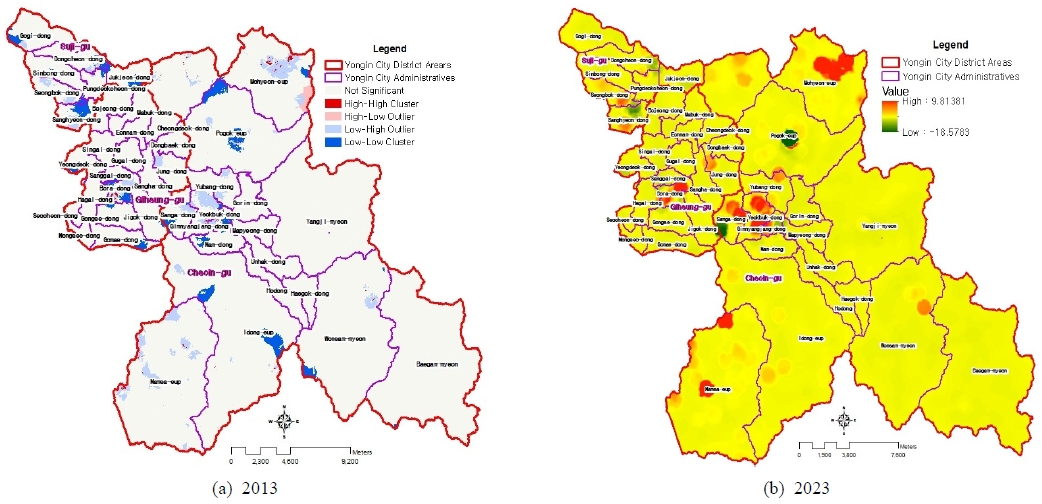
Result of changes in spatial distribution (2013–2023); (a) LISA, (b) Hotspot
By contrast, when examining the ten-year patterns using hotspot analysis, the results differed from those of the LISA analysis. Strong hotspots emerged in Mohyeon-eup, where large-scale redevelopment has occurred, and in Namsa-eup, where high-tech and agro-industrial firms are concentrated. Additionally, certain areas in Cheoin-gu (Samga-dong, Yeokbuk-dong, and Gimnyangjang-dong), Giheung-gu (Bora-dong), and Suji-gu (Seongbok-dong) exhibited relative increases in carbon emissions during the ten-year period. In contrast, Sanghyeon-dong in Suji-gu exhibited a decrease in emissions, making it the only neighborhood in Suji-gu where carbon emissions have declined. Meanwhile, part of Mohyeon-eup in Cheoin-gu appeared as a cold spot, indicating a localized reduction in carbon emissions.
Based on the observed changes in spatial patterns of carbon emissions, the following characteristics were identified for Yongin City:
First, the LISA analysis indicated significant spatial variation in HH clusters across districts in both 2013 and 2023. Specific neighborhoods in Suji-gu and Giheung-gu, such as Sanghyeon-dong, Dongcheon-dong, Bora-dong, and Sanggal-dong, consistently exhibited high levels of carbon emissions. Strong clustering patterns were especially evident in Suji-gu’s new town districts (e.g., Sanghyeon-dong and Dongcheon-dong), where large-scale residential and commercial developments are concentrated. Consequently, urban spatial policies targeting greenhouse gas reduction should prioritize new high-emission town areas. Active carbon-neutral practices by the central government, local government (Yongin City), and residents are essential in these districts. Furthermore, some of the HH clusters identified in 2013 expanded or newly appeared in Mohyeon-eup by 2023. In contrast, the HH clusters in Sanghyeon-dong and Dongcheon-dong (Suji-gu) contracted slightly during the same period. This indicates a relative increase in carbon emissions in the Mohyeon eup compared with other regions.
Second, LH and HL outlier clusters, representing areas with values that differed significantly from their surroundings, were found irregularly throughout Yongin City, including in regions previously identified as HH clusters, such as Bora-dong and Singal-dong in Giheung-gu, Suji-gu, and Cheoin-gu. This suggests that parcels with high carbon emissions are spatially concentrated in specific neighborhoods, particularly in high-density residential and commercial districts characterized by apartment complexes and mixed-use developments. In other words, parcels with high emissions tended to cluster in parts of Suji-gu and Giheung-gu, where high-rise residential buildings and commercial activities are densely located.
Third, hotspot analysis revealed that in 2013, there were five hotspot areas: Dongcheon-dong, Sanghyeon-dong, Pogok-eup, Samga-dong, and Bora-dong. By 2023, two additional hotspot areas, Mohyeon-eup and Namsa-eup in Cheoin-gu, were added to the five existing areas, resulting in a total of seven hotspots. This indicates that regions with high carbon emissions expanded spatially, particularly in Mohyeon-eup and Namsa-eup, compared to 2013. Notably, strong hotspot concentrations were observed in Suji-gu (Dongcheon-dong and Sanghyeon-dong) and Cheoin-gu (Pogok-eup and Samga-dong), where carbon emissions were relatively high. These findings highlight the need for Yongin City to broaden and strengthen its spatially targeted carbon reduction policies, particularly in areas with persistent or expanding hotspot patterns.
Fourth, the ten-year change in carbon emissions shows a sharp increase exclusively in the Mohyeon-eup and Cheoin-gu areas, which are undergoing large-scale redevelopment and new town formation. In contrast, reductions in carbon emissions were observed in certain parts of Suji-gu (Gogi-dong, Dongcheon-dong, Jukjeon-dong, and Sanghyeon-dong) and Giheung-gu (Sanggal-dong and Bora-dong). Several areas in Cheoin-gu, including Idong-eup, Pogok-eup, Wonsam-myeon, Gimnyangjang-dong, and Nam-dong, also exhibited partial decreases in emissions. Meanwhile, Mohyeon-eup and Namsa-eup emerged as strong hotspots for increasing carbon emissions, reflecting substantial growth in building energy consumption. Additional increases were observed in some areas of Cheoin-gu (Samga-dong, Yeokbuk-dong, and Gimnyangjang-dong), Giheung-gu (Bora-dong), and Suji-gu (Seongbok-dong). In contrast, Sanghyeon-dong in Suji-gu showed a decline in carbon emissions and was the only neighborhood in Suji-gu that exhibited a decreasing trend over the past decade.
5. Conclusion and implications
This study constructed a microscale, parcel-level spatial analysis dataset for evaluating building-sector carbon emissions in Yongin City and identified the spatial distribution characteristics and implications for carbon reduction. To achieve this, carbon emission values derived from electricity and gas consumption in 2013 and 2023 were spatially joined with parcel-level land price data (2023), enabling the development of a detailed GIS spatial database and the subsequent estimation of building-sector carbon emissions. By applying spatial joins to combine spatial and attribute datasets, we conducted a micro-level spatial analysis of energy use, which is far more detailed than traditional analyses conducted at the administrative district (dong) scale. Additionally, LISA (cluster–outlier) analysis and hotspot analyses were performed to identify the spatial patterns of carbon emissions across Yongin.
LISA results indicate that carbon emissions are highly clustered in specific neighborhoods, particularly in the newly developed districts of Suji-gu (Jukjeon, Pungdeokcheon) and Giheung-gu (Bojeong, Yeongdeok, and Dongbaek). Over the past decade, carbon emissions have increased sharply in Sanghyeon-dong and Dongcheon-dong, which are areas experiencing large-scale redevelopment, whereas emissions have declined in older districts, especially in Cheoin-gu. Sanghyeon-dong and Dongcheon-dong also exhibited slight reductions in spatial concentration patterns. Furthermore, LH outlier regions, representing unusual local–neighbor contrasts, appeared near the HH clusters in both years.
Hotspot analysis showed seven hotspot areas by 2023: Dongcheon-dong, Sanghyeon-dong, Pogok-eup, Samga-dong, Bora-dong, Mohyeon-eup, and Namsa-eup. These patterns closely mirrored the LISA findings. Notably, Mohyeon-eup and Namsa-eup were not hotspots in 2013 but transitioned into hotspot areas by 2023 as carbon emissions increased. This indicates that the high-emission areas expanded spatially over the decade, particularly in Mohyeon-eup and Namsa-eup.
Based on the spatial analysis of carbon emissions derived from electricity and gas consumption, the policy implications for carbon reduction in Yongin City are as follows.
First, comprehensive greenhouse gas management plans and reduction roadmaps must be established using microscale spatial information that accurately reflects parcel-level carbon emissions. LISA and hotspot analyses revealed substantial spatial disparities in building-sector emissions across administrative districts. Yongin City has established several policy frameworks, including the Energy Basic Ordinance (2019), the Carbon Neutrality and Green Growth Basic Ordinance (2023), the Sustainable Development Basic Ordinance (2025), and the Yongin Carbon Neutrality and Green Growth Basic Plan (2025). Therefore, carbon reduction strategies should be aligned with the spatial emission patterns revealed in this study and differentiated according to the local land use and energy consumption structures. Institutional improvements are required to ensure that microscale spatial results provide comprehensive GHG plans and roadmaps.
Second, urban spatial planning must incorporate the carbon emission characteristics associated with building energy consumption. The 2040 Yongin Urban Master Plan and other city-level plans are currently based on aggregated large-scale energy data. However, future urban planning should analyze carbon emission patterns at the administrative district or land-use level using detailed spatial data, such as those presented in this study. For example, in HL outlier regions, where local values exceed or fall below the surrounding values, planning interventions such as adjusting floor area ratios (FAR) may help reduce energy consumption and mitigate emissions. Similarly, HH regions should adopt strategies to limit excessive population inflow, such as regulating high-density apartment development or large-scale site development to prevent further increases in carbon emissions.
Third, it is necessary to designate spatially based carbon management zones centered on the hotspot and HH cluster areas identified in this study (e.g., Dongcheon-dong, Sanghyeon-dong, Bora-dong, Mohyeon-eup, and Namsa-eup). To this end, this study proposes the introduction of a differentiated spatial management system that moves beyond the existing uniform policy approach. In particular, high-emission areas (HH clusters and hotspots) should be subject to total energy consumption management and mandatory reduction obligations. In addition, transition areas (HL and LH outlier zones) should be managed through proactive intervention and diffusion prevention policies. Meanwhile, low-emission areas (LL clusters) should be designated as carbon-neutral maintenance and expansion zones. Such an approach is expected to enhance both the effectiveness of carbon policy design by reflecting spatial emission intensity and the precision of policy targeting.
This study contributes to the understanding of building-sector carbon emissions in Yongin City by conducting a microscale spatial analysis and deriving implications for local carbon neutrality strategies. It also provides insight into the spatial characteristics of energy consumption and offers directions for carbon reduction efforts at the local government level. However, this study had some limitations. Carbon emissions were estimated solely based on electricity and gas consumption, leading to constraints in achieving a comprehensive sector-wide analysis. In particular, since carbon emissions were estimated solely based on electricity and gas energy consumption, this study has a limitation in that other energy sources, such as district heating, were excluded. Moreover, discrepancies may exist between the parcel-level spatial information and the spatial accuracy of energy consumption records. The causal mechanisms behind the emission patterns, particularly the concentrations of LH or HL outliers near the HH clusters, have not been fully examined. Therefore, future research should adopt integrated analytical approaches that encompass the building, transportation, and carbon removal sectors to overcome these limitations and enhance the comprehensiveness of carbon emission modeling.
References
- Allen M, Dube OP, Solecki W, Aragon DF, Cramer W, Humphreys S, Kainuma M. 2018. Special report: Understanding housing abandonment and owner decision-making in Flint. Michigan: An exploratory analysis. Working paper.
-
Anselin L. 1995. Local Indicators of Spatial Association—LISA. Geogr Anal 27(2): 93-115.
[https://doi.org/10.1111/j.1538-4632.1995.tb00338.x]

-
Choi YS, Kim JW, Lim E. 2018. Spatial patterns of heatwave vulnerable areas and analysis of adaptive capacity vulnerability in Seoul. J Korea Plann Assoc 53(7): 87-107.
[https://doi.org/10.17208/jkpa.2018.12.53.7.87]
-
Gao H, Sun M, Zuo L. 2026. An LCA-BIM-GIS integrated model for net carbon emission quantification of buildings. J Build Eng 120: 31-53.
[https://doi.org/10.1016/j.jobe.2026.115392]
-
Hong NE. 2024. A foundational study on spatial decision-support models for climate change responses: Focusing on a review of previous research. J Clim Change Res 15(3): 385-399.
[https://doi.org/10.15531/KSCCR.2024.15.3.385]
- IPCC (Intergovernmental Panel on Climate Change). 2023. AR6 synthesis report: Climate change 2023.
- Jones A, Smith B, Brown C. 2019. Building energy modeling and simulation: A review. Energy Policy 38(4): 201-212.
-
Jung YS, Moon SH, Cho SH. 2021. Estimation and characteristics of greenhouse gas emissions in the building sector. J Clim Change Res 12(4): 299-306.
[https://doi.org/10.15531/KSCCR.2021.12.4.299]
-
Kang SM, Cha JW, Yoo JM, Lee SJ. 2024. A study on the application of major emission source analysis of local greenhouse gas inventories: Focusing on Seoul. J Clim Change Res 15(3): 401-413.
[https://doi.org/10.15531/KSCCR.2024.15.3.401]
- Kim DG, Lee JH, Park HS, Lee JB, Jung JS. 2013. Estimation and analysis of building sector greenhouse gas emissions using the national energy census. J Energy Clim Change 8(1): 30-44.
- Kim DG, Son IS. 2019. Analysis of Korea’s peak greenhouse gas emissions. Korea Energy Economics Institute Report.
-
Kim DH. 2015. Analysis and utilization of spatial big data for planning support: Focusing on building energy data in the Seoul metropolitan area. KRIHS Res 87: 163-178.
[https://doi.org/10.15793/kspr.2015.87..011]
- Lee MS, Yeo KH. 2021. Spatial pattern analysis of the regional safety index using spatial autocorrelation: Focusing on basic local governments. J Korean Soc Surv Geod Photogramm Cartogr 39(1): 29-40.
-
Lim HC, Park YH. 2017. Spatial patterns of local safety in Korea. Local Gov Stud 21(3): 385-407.
[https://doi.org/10.20484/klog.21.3.15]
-
Ma J, Cheng JC. 2016. Estimation of the building energy use intensity in the urban scale by integrating GIS and big data technology. Appl Energy 183: 182-192.
[https://doi.org/10.1016/j.apenergy.2016.08.079]
- Müller D, Zhang Y, Wang L. 2020. Life cycle assessment of buildings: A critical review. Build Environ 45(5): 123-135.
- Park HS, Ahn JW, Lee HE, Park HJ, Oh SS. 2023. Review of domestic and international scenarios, technologies, and policy trends for achieving carbon neutrality in the energy sector. Korean Chem Eng Res 61(4): 496-504.
-
Park SH, Lee CH, Jung KM, Yeom SC. 2024. Diagnosing the implementation status of Korea’s 2030 greenhouse gas reduction target through regional energy plans and emission analyses. J Clim Change Res 15(3): 327-341.
[https://doi.org/10.15531/KSCCR.2024.15.3.327]
- Park SY, Jung JY, Yoo HW, Jung HW, Lee JY. 2021. Urban decline pattern analysis based on spatial hierarchical structure considering local characteristics. J Korean Soc Surv Geod Photogramm Cartogr 39(6): 571-585.
-
Rahmati B, Rabiei-Dastjerdi H, Bibri SE, Aghajani MA, Kazemi M. 2024. Reducing urban energy consumption and carbon emissions: A GIS-based model for spatial accessibility. Comput Urban Sci 4(37): 1-32.
[https://doi.org/10.1007/s43762-024-00139-9]
- Shin HP, Choi JM. 2022. Characteristics of greenhouse gas emissions by building use: Analysis based on 2018–2021 Green Together data. J Archit Inst Korea 38(8): 237-246.
-
Yeo KH. 2024. Spatial distribution of greenhouse gases by use in the building sector and carbon neutral policy direction in Anyang-si, Gyeonggi-do. J Korean Soc Surv Geod Photogramm Cartogr 42(2): 113-122.
[https://doi.org/10.7848/ksgpc.2024.42.2.113]
-
Yeo KH, Lee MS. 2023. Spatial pattern changes and distribution characteristics of Korea’s regional safety index: Focusing on differences between 2015 and 2020. J Korean Soc Surv Geod Photogramm Cartogr 41(5): 331-342.
[https://doi.org/10.7848/ksgpc.2023.41.5.331]
-
Yeo KH, Yoo SC. 2023. Spatial distribution and carbon neutrality policy direction for building sector greenhouse gas emissions in Suwon City. J Korean Soc Surv Geod Photogramm Cartogr 41(2): 99-107.
[https://doi.org/10.7848/ksgpc.2023.41.2.99]
- Yoo SC, Shin DB, An JW. 2019. Spatial analysis of building sector greenhouse gas emissions in Seoul using spatial big data. J Korean Soc Geospatial Inf Sci 37(4): 11-19.