
벼 재배 시 대형농기계 사용 및 농법에 의한 탄소중립 방안

Abstract
This study examines the impacts of climate change on agricultural productivity, the current status of greenhouse gas (GHG) emissions in agriculture, and the environmental effects of large-scale agricultural machinery. It also reviews technological and policy strategies for achieving carbon neutrality in agriculture. Rising temperatures and elevated atmospheric CO2 concentrations influence crop growth and yields, underscoring the importance of region- and crop-specific adaptation measures. Major sources of GHG emissions include fertilizer use, machinery operation, and livestock management. The expansion of large machinery worsens soil compaction and degradation, reducing carbon sequestration capacity and long-term productivity. International carbon neutrality roadmaps, such as those proposed by the IEA, IRENA, and major economies, highlight energy demand reduction, decarbonization of power generation, electrification, and carbon capture as key strategies. These global approaches provide useful references for developing domestic agricultural policies. Achieving carbon neutrality in agriculture will require both technological innovation and institutional support. The adoption of eco-friendly and energy-efficient machinery, precision and smart farming technologies, and low-carbon practices must be accompanied by policy instruments such as farmer education, financial incentives, and carbon pricing. An integrated approach that combines technological, managerial, and policy efforts can simultaneously enhance productivity and environmental sustainability. This study provides comprehensive insights into designing effective carbon-neutral strategies for the agricultural sector and strengthening resilience to climate change.
Keywords:
Carbon Neutrality, Agricultural Sector, Carbon Reduction Practices, Greenhouse Gas Mitigation, Net-Zero Emissions1. 서론
전 세계적으로 산업화와 인간 활동의 증가로 에너지 소비가 급격히 증가하면서, 2022년 기준 약 500억 톤의 온실가스가 배출되었다(Seo et al., 2022). 이러한 온실가스는 지구온난화를 가속화시키며, 그에 따른 이상기후 현상은 세계 곳곳에서 점차 심화되고 있다(Seo et al., 2022). 우리나라의 경우, 온도가 2°C 높아지면 주식인 벼의 출수 기간이 7 ~ 8일 단축되어, 수량이 약 4.5% 감소하고, 온도와 동시에 이산화탄소(CO2) 농도가 증가하게 되면 전국 평균 14.9% 수량이 감소한다고 예측하였다(Shim et al., 2010). 또한 현재의 기후변화를 가정했을 때 한반도의 벼 생산량은 지역 및 출수생태형에 따라 21.6 ~ 31.1% 감소할 것으로 전망되었다(Lee et al., 2011, 2021). 전 세계적으로도 기후변화의 영향은 명확하게 나타나고 있다. 과거(1980 ~ 2008) 평년에 비해 전체 수량이 0.1% 감소할 것으로 예측되었고, 10년 주기 생장율 또한 1960년대에 비해 향후 10년간 1.5% 감소할 것으로 분석되었다(Lobell and Gourdji, 2012; Lobell et al., 2011). 만약 재배 지역의 이동이 없다면 아시아의 쌀 수량은 평균적으로 10.4% 감소할 것으로 전망된다(Horie, 2019; Matsui et al., 1997; Yoshimoto et al., 2011).
일본의 경우, 기후변화 시나리오(RCP 8.5) 하에서 이앙시기를 조절하면 수량과 품질 측면에서 A등급 쌀이 71.1 ~ 91.5%로 70% 이상 증가할 수 있는 반면(Ishigooka et al., 2017), 같은 조건에서 2040년대에는 분상질립이 2배 이상 증가되어, 연간 4억 달러의 경제적 손실이 발생할 것으로 추정된다(Masutomi et al., 2019). 우리나라 또한 RCP 8.5 시나리오에 따라 기온이 현재보다 2.8°C 상승하고, CO2 농도가 580 ppm까지 증가할 경우, 현미 천립중은 12%, 등숙률은 24%, 쌀 수량은 33% 감소할 것으로 예측되며, 출수 시기가 앞당겨짐에 따라 고온등숙 환경에 노출될 가능성도 높아질 것으로 보인다(Sang et al., 2018). 이처럼 한국과 일본을 포함해 전 세계적으로 다양한 작물에서 피해가 기후변화로 인한 피해가 확산되고 있다. 이에 많은 국가들이 기후위기 극복을 위한 대응 방안으로 탄소중립(Carbon Neutrality) 목표를 선언하고 있다.
대표적으로 EU, 미국, 일본, 한국 등이 2050년 탄소중립을 선언하였고, 중국은 2060년 탄소중립을 선언하였다(Park, 2021). 우리나라는 2020년 10월 28일, 국제사회에 2050년 탄소중립 목표를 공식 선언하였으며, 같은 해 12월 7일에「2050 탄소중립 추진전략」을 수립·발표하며 기후위기 대응에 본격적으로 동참하였다(Jung et al., 2022).
특히, 우리나라 농·축·수산 부문의 2050년 탄소중립 시나리오는 다음의 세 가지 목표를 지향하고 있다. ① 식량안보 담보 ② 온실가스 감축을 통한 농어촌과 농어업의 지속가능성 향상 ③ 안전하고 건강한 먹거리의 생산과 소비. 이를 실현하기 위해 적용 가능한 기술과 정책 수단을 최대한 반영한 시나리오가 마련되었다(Kang, 2023).
한편, 기후변화 대응을 위한 정부간 협의체인 IPCC (Intergovernmental Panel on Climate Change)는 2100년까지 지구 평균기온 상승 폭을 1.5°C 이내로 제한하기 위해, 전 세계적으로 2030년까지 CO2 배출량을 2010년 대비 최소 45% 감축하고, 2050년까지는 탄소중립(Net-zero)을 달성해야 한다는 경로를 제시하였다(Seo et al., 2022). 또한, IPCC 제 6차 평가보고서에서는 2021년 11월까지 제출된 국가 감축목표 만으로는 1.5°C 목표를 달성하기 어려우며, 1.5°C 목표를 달성하기 위해서는 2050년까지 전세계 온실가스 순배출량을 2019년 대비 84% 감축해야 한다고 밝히고 있다(IPCC, 2022).
이러한 국제적인 감축 요구는 국가 단위의 정책뿐만 아니라 산업, 농업, 사회 전반에 걸친 체계적인 대응을 요구하고 있으며, 특히 배출 저감 여력이 낮은 부문에 대한 기술적·제도적 지원이 절실하다. 한국의 온실가스 배출량과 농업 부문 주요 변수들 간의 관계 분석 결과, 장기적으로 농업기계로부터의 배출량이 이산화탄소 배출량에 양(+)의 영향을 미치는 것으로 나타났다(Lee and Lee, 2018). 따라서, 본 논문에서는 심화되는 기후 위기에 효과적으로 대응하기 위한 탄소중립 실현 전략과 이를 뒷받침할 다양한 기술적, 사회적 접근 방향에 대하여 고찰하고자 한다.
2. 지구온난화 현황
2.1. 온실가스 배출 현황과 전망
산업혁명 이후 급격한 온도상승은 인간의 활동으로 인해 발생한 인위적 온실가스 농도의 증가에 기인할 가능성이 매우 크다고 평가하였다(Park et al., 2021). 온실가스는 이산화탄소(CO2), 메탄(CH4), 아산화질소(N2O), 육불화황(SF6), 수소불화탄소(HFCs), 과불화탄소(PFCs), 염화불화탄소(CFCs) 등이 존재하고, 농축산에서 배출되는 온실가스는 CO2, CH4 그리고 N2O로 3종류이다. 이 중 농경지에서 CO2 배출은 석회나 요소 시용과 같은 인위적인 농업 활동에 의해 발생하는 경우 온실가스 배출량에 포함되지만(Beak et al., 2023), 자연적인 생태계 순환의 일부로써 작물의 광합성과 호흡으로 인한 흡수와 배출은 균형을 이루므로 현재 온실가스 배출량 계산에는 해당 사항이 포함되지 않는다(RDA, 2021).
세계 온실가스 종류별 배출량은 약 49.4억 톤 CO2eq.로 추정되며, 그 중 에너지 부문이 전체 배출량의 73.2%를 차지하여 가장 큰 비중을 나타냈다(Fig. 1). 농업, 산림 및 토지 이용은 18.4%로 나타났다. 농업 부문에서는 가축 및 분뇨 5.8%, 작물 경작 4.1%, 산림 파괴가 2.2%로 높은 비중을 보여, 농업활동이 온실가스 배출에 있어 중요한 기여 요인임을 확인할 수 있다. 다만, 농업은 다양한 경로를 통해 온실가스를 배출하지만, 동시에 탄소를 저장하고 흡수할 수 있는 잠재력을 함께 가지고 있으며, 이는 단순히 배출을 감소하는 개념을 넘어서 기후위기를 완화하고 생태계를 회복시키는 기회를 제공할 수 있다.
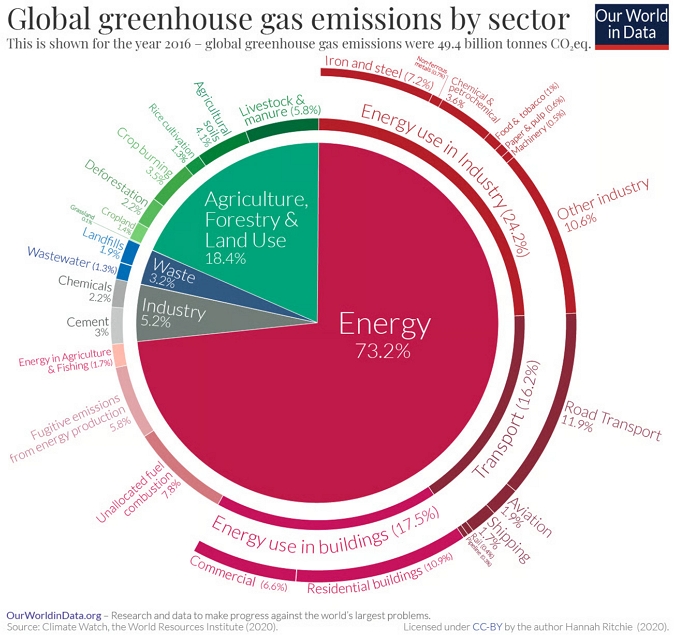
Global greenhouse gas emissions by sectorSource: Ritchie (2020)
우리나라의 2021년 온실가스 총배출량은 676.6백만 톤 CO2eq.이며, 1990년에 비해 131.6% 증가하였고, 2020년보다 3.4% 증가하였다(Table 1). 에너지와 산업공정 부문에서는 산업화와 경제 성장에 따른 에너지 소비 증가 및 공정 과정의 배출 증가에 기인하여 각각 1990년 대비 144.6%, 151.4% 증가하여, 2021년에는 각각 587.7백만 톤, 51.4백만 톤 CO2eq.에 달하였다. 반면, 농업 부문의 온실가스 배출량은 1990년 21.0백만 톤에서 2021년 21.4백만 톤으로 거의 변동이 없었다. 배출량이 증가하지 않는 것은 경종부문의 배출량은 감축하고 있지만, 축산부문은 배출량이 증가한 결과이다. 농업 부문에서의 온실가스 감축이 제대로 이루어지지 않고 있는 것으로 해석할 수도 있다. 전체 배출량이 크게 증가하는 상황에서 농업 분야의 배출량이 정체된 것은 농업 생산방식의 비효율성과 저감 기술 도입 부족을 반영하는 것으로 사료된다. 앞으로 농업 부문 온실가스 배출 저감을 위해서는 기술 개발뿐만 아니라 농업인 인식개선, 정책적 지원 강화, 세부 원인별 맞춤형 감축 대책 마련이 시급하다.

Greenhouse gas emissions and removals by sector in South Korea
2.2. 농업에서 온실가스 배출 현황과 감축 목표
농·축·수산 부문은 2030년까지 온실가스 배출의 주요 원인 중 하나로, 저탄소 농업, 가축 관리, 고효율에너지시설 보급 등을 통해 온실가스를 2018년 대비 37.7% 감축해야 한다.
저탄소 농업은 논물관리, 비료 사용 최적화, 바이오차 활용 등을 포함하며, 이를 통해 CH4과 N2O 배출을 효과적으로 줄이는 데 집중한다. 가축 관리에서는 저질소 사료 공급과 분뇨 처리 개선을 통해 가축 분뇨에서 발생하는 온실가스를 감축할 수 있다. 또한, 농업 현장에 고효율 에너지 설비를 보급하고 재생에너지 사용을 확대함으로써 에너지 부문에서 발생하는 배출량도 크게 줄일 수 있다(Table 2).
Definitions of greenhouse gas reduction measures
이와 같은 온실가스 감축 노력은 단순한 배출 저감에 그치지 않고, 농업 생산성 유지와 생태계 건강을 함께 고려해야 하는 복합적인 과제이다. 따라서 저탄소 농업 기술과 가축 관리 개선은 현장의 현실적인 조건에 맞게 보급되어야 하며, 농민들의 인식 제고와 적극적인 참여가 필수적이다. 더불어, 농촌 지역의 지속 가능한 발전과 환경 보전에 기여하기 위해서는 기술적·정책적 지원뿐만 아니라 농업 주체 간 협력과 통합적 접근이 무엇보다 중요하다.
2050 탄소중립 감축로드맵에 따르면(Table 3), 농업 부문은 2030년 약 5,858천 톤, 2050년 8,243천 톤 CO2eq.의 감축 목표를 설정하고 있으며, 간단관개, 바이오차 토양 활용, 저메탄 사료 보급, 가축분뇨 처리 개선, 스마트 축산 기술 및 농기계의 전기·수소화 확대 등 다양한 전략이 포함되어 있다. 하지만, 실질적인 성과 달성을 위해서는 기술적 진보와 더불어 정책적 지원, 교육 및 인센티브 제공, 농업 주체 간 협력 강화 등이 병행되어야 하며, 이를 통해 농업 부문의 탄소중립 실현 가능성을 높여야 할 것이다.
2050 Carbon Neutrality Reduction Roadmap
3. 대농기구 사용의 환경적 영향
3.1. 대농기구의 종류 및 역할
벼 재배 시 포장에서 이루어지는 작업의 기계화 비율은 빠른 속도로 증가하여 1990년대 중반에 90% 이상이었고, 2010년 이후에는 100% 근접하였다. 2021년 전국의 농기계 공급 대수는 193만 대로, 2018년(187만 대)보다 약 3.11% 증가했다(Lee and Kang, 2023). 경운기 등의 소형 기계의 사용은 대폭 감소였고, 작업 효율이 높은 대형 트렉터, 승용 이앙기, 산물형 콤바인 사용이 일반화되었다(Kim et al., 2021). 또한 2021년 기준 대형 트랙터 공급대수가 전체의 61.4%를 차지했고, 이앙기는 99.9%, 콤바인은 86.0%를 차지하여, 농기계의 대형화 추세가 이어지는 경향을 보였다(Lee and Kang, 2023).
현재 국내에서 가장 일반적인 중묘 이앙체계를 기준으로 트랙터, 플라우, 로타베이터, 이앙기, 콤바인 등의 농기계 종류가 다양하게 존재하고 있다(Table 4). 트랙터는 여러 작업 도구를 부착하여 사용하거나, 농기계 등을 운반할 수 있는 기구로, 토양 경작부터 운반, 파종, 수확까지 폭넓게 활용되어 기계화 작업의 중심 역할을 하고있다. 플라우는 트랙터에 부착해 심경을 할 수 있는 장비로, 쟁기 기능을 수행하는 장비이다. 로타베이터도 트랙터에 부착해 토양을 부순 후 고르게 만드는 장비로 플라우와 유사하다. 이앙기는 모판에서 키운 모를 논에 자동으로 심어주는 기계로, 벼농사에서 높은 작업 효율성을 보여준다. 콤바인 수확기는 벼 수확, 탈곡, 왕겨 분리 작업을 한 번에 수행하는 농기계로, 가격이 비싼편이지만, 작업 효율성을 크게 향상시킨다.
Agricultural machinery used in rice cultivation
3.2. 온실가스 배출 측면
논벼 재배에 투입되는 농업기계 중 대형 기종의 보급률은 꾸준히 증가하고 있다. 2021년을 기준으로 트랙터(60 ps 이상), 승용이앙기, 5조 이상 콤바인의 대형 규격 비율은 각각 61.4%, 99.9%, 86.0%를 기록하였으며, 이는 2010년에 비해 각각 19.4%, 9.5%, 33.2% 증가한 수치이다(Shin et al., 2022). 이와 같은 기계 대형화는 농작업의 기계화율 및 작업 효율을 제고함으로써 노동력 절감에 기여해 왔다.
농업계의 효율적인 운용은 온실가스 배출과도 밀접한 관련이 있다(Lee and Kim, 2023). 농업 분야의 에너지 소비구조를 살펴보면, 2019년 기준 농업기계용 에너지 소비가 전체 농업 에너지 소비의 45.7%를 차지하며 가장 높은 비중을 차지하고 있다. 이는 2013년 이후 연평균 약 2.6%씩 감소해왔으나, 여전히 높은 수준을 유지하고 있다(Table 5).
Trends in energy consumption by usage in the agriculture and fisheries sectors
농업기계별 CO2 배출량은 트랙터, 경운기, 농산물건조기 순으로 배출량이 많았다. 에너지 소비량이 많을수록 CO2 배출량이 많았고, 트랙터, 경운기 및 곡물건조기의 배출량을 합하면 전체의 절반을 초과하는 배출량을 나타냈다(Table 6). 디젤엔진을 사용하는 경유 농기계는 높은 연료 효율을 가지지만, 다량의 온실가스뿐만 아니라 미세먼지까지 배출되는 것으로 알려져있다(Ha, 2020).
Energy consumption and greenhouse gas emissions of agricultural machinery (2005)
농기계 작업의 빈도와 기종의 규모는 온실가스 배출량에 큰 영향을 미친다. 대형화된 기계일수록 단위 시간당 작업 면적은 넓지만, 그에 비례해 연료 사용량도 증가하고, 그에 따른 온실가스 배출량도 증가하게 될 것이다. 하지만, 동일한 면적에 대해 작업한다고 가정할 경우, 대형기계는 적은 운행 횟수로 작업을 완료할 수 있어 단위면적당 탄소배출량을 오히려 감소할 수 있다. 생산성과 환경성을 고려한 기계 운영 방안이 중요하고, 정밀 농업의 접목, 저탄소 연료전환, 운전자 교육 등 운용 체계의 개선이 필요할 것이다.
3.3. 토양 및 생태계의 역할
최근 우리나라 농업 현장에서는 노동력 감소, 작업 효율성 향상, 편의성 증대 등을 목적으로 농기계의 대형화가 빠르게 진행되어왔다. 이러한 변화는 많은 장점을 가지고 있지만, 효율적인 사용을 위해 해결해야 하는 몇 가지 문제점이 존재한다. 가장 대표적인 문제 중 하나는 토양다짐 현상이다. 토양다짐 즉 견밀화는 수분이동을 불량하게 하고, 토양 저항력을 증가시켜 뿌리 성장을 방해하여 작물의 수확량을 최대 30 ~ 50% 감소시킨다(Gill and Vanden Berg, 1967; Niwa et al., 1999; Park and Lee, 2002; Raghavan et al., 1979; Yun et al., 2011). 이러한 토양 경반화는 토지 이용의 증가, 부적절한 토양관리, 다모작지대 등의 농작업 빈도와 강도가 증가할수록 심해진다고 하였다(van den Akker, 1994; Yun et al., 2011). 논은 밭에 비해 상대적으로 저지대에 위치하여 비담수기에도 토양수분함량이 소성한계(Plastic Limit) 이상으로 높게 유지되기 쉬워 경운 시 사용하는 농기계 하중의 더 큰 영향을 받는다(Han, 2018; Saito, 1985).
콤바인 작업 전·후로 슬립 구간에서 최대 저항값의 변이가 크게 나타나, 심토가 교란되었음을 확인할 수 있었고, 경운의 농기계 반복적 사용은 표토 압밀을 유발해 토심 20 cm 부근에 경반층(1.76 Mpa)이 형성된다(Yun et al., 2011). 경반층이 위치한 토층의 상부(작토층 포함)에 비해 하부에서 급격한 화학성 변화가 일어났으며, 특히 배수 약간불량 미사식양질토에서 유기물, 유효인산 및 치환성 칼리 함량이 감소한 반면, pH와 치환성 칼슘 및 마그네슘 함량은 오히려 증가하였다(Yun et al., 2011). 경반층은 보통 토심 20 ~ 30cm 범위에 형성되고, 경반층은 토양 수분의 수직이동을 방해하고, 용적밀도 증가, 공극률 감소, 통기성 저해, 수분퍼텐셜이 저하에 따른 수분공급 저해로 한발 패해 및 강우시 습해가 발생할 수 있다. 또한 토층에 따라 양이온 분포가 크게 달라져(Hamza and Anderson, 2003; Yun et al., 2011) 작물의 생육에 영향을 미친다. 토양 공극률의 감소되면, 미생물 활동이 감소하게되고, 유기물 분해 및 탄소 고정 과정에 부정적인 영향을 초래한다. 이는 장기적으로 보았을 때 작물의 생산성 저하와 탄소 저장능력 또한 함께 감소할 위험이 있고, 토양 내 탄소 저장량이 감소하여 탄소중립 달성을 어렵게 할 수 있다.
이러한 경반층은 농기계 대형화로 인해 점점 강도와 두께가 증가하고 있다(Jung et al., 2012). 이를 심토파쇄기를 이용하여 약 40 cm 깊이로 심경하여 심토를 파쇄할 경우, 최대 저항값이 약 1.2 MPa로 감소하고, 토양 물리성도 개선 및 토양 수분 이동량의 증가로 EC가 감소하였다. 또한 비파쇄 처리 대비 약 18 ~ 30% 증수하였다(Cho et al., 2000; Hamza and Anderson, 2003). 이는 단순한 물리적 파쇄효과를 넘어서, 토양의 구조적인 회복과 생물학적 기능의 개선까지도 기대해 볼 수 있는 중요한 관리방법임을 알 수 있다. 따라서, 경반층의 생성을 미리 방지하기 위해 적절한 토양관리 및 대형 농기계의 하중을 분산하거나, 작업 빈도를 조절 및 아예 사용하지 않고 재배할 수 있는 예방적 접근도 필요하다.
4. 탄소중립을 위한 대농기구의 전환 방향
4.1. 친환경 지향 농기계 개발
농업분야에서도 에너지 비용의 저감과 환경친화적 동력 기술의 중요성이 대두되고 있고, 농산물 생산에 있어, 온실가스 발생 저감 및 에너지 이용 효율화로 청정생산체계 구축이 농업의 미래를 준비(Kim et al., 2015)하는 바른 자세라 할 수 있다. 1960년 이후 농업기계화의 필요성이 대두되어 1972년 농업기계화 5개년 계획이 최초 수립 및 시행되었다. 이후 2000년대부터 농기계 구입자금의 융자지원 및 임대사업을 추진하였고, 2010년 이후부터는 스마트팜을 비롯해 미래 첨단농업을 위한 ICT 융복합 기반의 농업기계화가 추진 중이다(Table 7).
Government's agricultural mechanization progress and future plans
기후변화로 인한 기상이변 발생빈도의 증가로, 각 국가별 정부 및 농기계 업체도 미세먼지 저감을 위한 전기 및 수소를 활용한 농기계 개발과 탈내연기관 농기계 개발에 박차를 가하며 온실가스 감축에 동참하였다. 우리 정부도 전기나 수소 등 친환경에너지 동력원으로 전환하기 위한 계획을 수립하고, 미세먼지 저감을 위해 2021년부터 농협 면세유 관리시스템에 등록된 노후화된 농기계 조기폐차 지원정책 등을 추진 중에 있다(Lee and Kang, 2023). 미국과 유럽은 1990년대부터 하이브리드 동력기술이 기반이 되는 전기 트랙터에 관한 연구를 추진중에 있으며, 존디어(John Deere), Case IH사 등을 중심으로 하이브리드 트랙터 모델 개발을 추진해 왔다(Kim et al., 2015). 하이브리드 시스템은 화석 연료의 사용을 절감하고 유해 배기가스의 발생을 줄이기 위해 내연기관(엔진)과 전기동력(모터)을 결합한 시스템이다(Bae, 2002; Kim et al., 2014). 이러한 하이브리드 동력 시스템은 농기계에서도 연료 사용효율 향상 및 유해 배기가스 감소에 매우 유용한 것으로 나타났다. 특히, 폐쇄된 작업환경에서 농기계가 배출하는 배기가스는 환경뿐만 아니라 사람에게도 큰 영향을 미치기 때문에 유해 배기가스 배출이 적은 하이브리드 농기계의 실용화가 필수적이다. 하지만, 여전히 높은 제조비용과 복잡한 시스템은 지속적으로 해결해야 할 과제이다(Kim et al., 2015).
4.2. 스마트 농업 기술과의 융합
기후스마트농업은 지속가능한 농업시스템을 계획하고 개발하는 데 있어 기후변화 문제를 체계적으로 통합하여 해결하려고 하는(Lipper et al., 2014) 등 기존의 여러 영농방식과는 차이가 있다고 할 수 있다(Kang, 2017). 이러한 기후스마트농업에 적용되는 기술은 수량 증가, 온실가스 완화, 복원력 증가(기상이변 대응) 등을 추구하고, 원천 분야별로 크게 물, 에너지, 양분, 기상, 기타 등으로 유형화하여 Table 8과 같이 나타냈다. 국내 주요 기후스마트농업 사례로, 논물 얕게대기, 지열히트펌프, 다겹보온커튼, 맞춤형 비료, 녹비재배 및 농업 기상재해 조기 경보시스템 이 6종을 예비조사를 통해 실제 농가에서 많이 적용되고, 선호하는 기술로 경제적, 정책적 파급영향이 클 것으로 판단된다(Jung et al., 2016).
Farm-level inventory of climate-smart agriculture measures by sector
정밀농업(Precision Agriculture) 기술은 생산과정을 모니터링하고 최적화하기 위해 디지털을 활용하는 농업관리 및 농업경영의 개념으로, 적은 투입량(물, 에너지, 비료, 농약 등)으로 비용을 절감하고, 환경오염 등 환경에 미치는 영향을 최소화하며, 식량자원의 양과 품질을 향상 시키는 것을 목적으로 한다. 정밀농업은 다양한 농업기계 및 차량에 장착된 센서를 통해 획득한 원격 감지 이미지의 사용이 가능하여 정밀농업 시장은 연평균 12% 증가하였고, 앞으로도 원격 감지 장치가 작물과 관련된 중요한 정보를 캡처함에 따라 정밀농업에서 실시간 의사결정 응용 프로그램을 지원하기 위해 그 유용성이 꾸준히 증가할 것이다(Seo et al., 2020). 이러한 정밀농업 기법을 적용은 비료 효율성 증가(Evangelou et al., 2020), 제초제 사용 저감(Kempenaar et al., 2017), 온실가스 배출량을 감소(Balafoutis et al., 2017; Soto et al., 2019), 농약 잔류량 감소(Fabiani et al., 2020), 질병억제(Liu et al., 2017) 등의 환경적 이익을 기대할 수 있다.
IoT 기반 모니터링 시스템은 농업 현장의 데이터를 분석해 최적 작업을 제시할 수 있는 중요한 기술로, 이를 통해 기계 등의 가동 시간을 효율적으로 관리하고, 사용 횟수도 줄일 수 있을 것이다. 최종적으로 이러한 기술들의 기술적 융합을 통하여, 실질적으로 농업 현장에 효과적으로 적용될 경우, 농업은 더욱 지속가능한 방향으로 발전할 수 있을 것이다.
4.3. 농업 실천 방식 및 농가 인식 개선을 통한 지속가능한 전환
농업 부문에서 탄소중립 실천을 위한 여러 노력이 진행 중이지만, 단순히 농기계 연료 대체만으로는 충분하다 할 수 없다. 농기계 이용에 따른 온실가스 발생은 감축할 수 있지만, 농업 생산과정에서 발생하는 온실가스에 대해서 효과적인 감축이 어려운 실정이다.
특히, 지속가능한 농업으로의 전환은 단순한 기술적 교체보다 농업 실천 방식의 변화를 병행할 때 더욱 효과적일 것이다. 예를 들어, 토양 관리 방식에서 경운의 정도에 따라 온실가스 배출과 에너지 소비가 달라진다. 관행경운은 경운·쇄토·이랑 형성 등 여러 단계의 작업으로 인해 농기계 사용량이 많아 연료 소비와 탄소배출이 크게 증가한다. 반면, 최소경운은 일부 작업을 줄여 에너지 사용을 줄이고, 무경운은 경운 자체를 생략함으로써 농기계 투입을 최소화하고 토양 탄소 저장능력을 강화한다. 이러한 경운 방식의 변화는 현장에서 실천가능한 대표적 저탄소 농법이라 할 수 있다. 저탄소 농업기술은 비료, 농약, 농자재 및 에너지 절감을 통해 온실가스 배출을 줄이는 영농방법 및 기술을 의미하고, 최적 비료사용, 경축순환농법, 자가제조 농자재 사용, 풋거름 작물재배, 순환식 수경재배, 생물적 자원을 이용한 제초 및 방제 기술이 있다(Table 9).
Low-carbon agricultural technologies
농업인들이 탄소중립의 필요성과 지속가능한 농법의 효과를 인지하지 않는다면, 제도적 지원이나 기술의 도입이 농업 현장에서 정착되기 어려울 것이다. 이를 위해 교육 및 홍보와 시범사업 등을 추진하고, 친환경인증에 대한 가격부담을 줄이기 위해 보조금 지원, 탄소배출권 거래제에 대한 인센티브 제공 등 경제적 지원을 병행하면 효과적일 것이다. 이러한 농가의 인식개선은 정책 및 기술의 변화에 실질적 실행 및 도입을 좌우하게 될 것이다. 결국 농업에서 탄소중립은 농기계 전환(친환경 농기계), 농법 변화(저탄소, 보존농업, 정밀농업, 재생농업 등), 인식개선이 상호적으로 작용할 때 그 시너지 효과가 증대될 것이다.
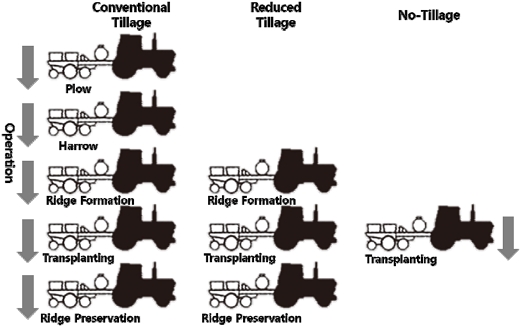
Utilization of agricultural machinery by tillage methodSource: RDA (2021)
5. 사례 분석
5.1. 전기 농기계 도입한 선진국 사례
최근 여러 선진국에서 순수 배터리를 적용한 전기차 타입의 트랙터를 개발하여 상용화하고 있다. 소형 트랙터는 주로 과수 작업, 주말농장이나 소규모의 농장의 경부하 작업이고, 중형이상의 트랙터는 노지 농업 수행을 목표로 기술 개발 및 발전이 추진되고 있다.
미국의 John Deere는 2007년 전기 및 하이브리드 트랙터를 상용화한 이후, 최근에는 배터리 용량 한계와 같은 제약을 극복하기 위해 전원 연결형 전기 트랙터 개발을 추진하고 있다. 또한 2021년에는 compact utility급 이하 트랙터의 전동화 목표를 제시하였으며, Cummins 등 협력 기업과 함께 배터리 및 수소연료전지 모듈의 상용화를 추진 중이다. 일본의 Kubota는 2024년 유럽 및 일본 시장 출시를 목표로 도심용 전기 트랙터 시제품을 선보였으며, 현재 실차 시험을 수행 중이다. 더불어 2030년까지 중소형 트랙터 판매 모델의 30% 전동화를 목표로 하고 있다. 독일의 FENDT는 2017년 전기 트랙터 시제품을 공개한 이후 실차 검증을 지속적으로 수행하고 있으며, 특히 배터리 시스템과 열관리 솔루션에 관한 연구개발에 주력하고 있다. 이를 기반으로 2025년 양산화를 목표로 하고 있다. 미국의 Monarch는 2020년 자율주행형 전기 트랙터 시제품을 개발하여 캘리포니아 지역에서 실증을 진행하였고, 이후 CNH와 EV 기술에 관한 장기 독점계약을 체결하였다. 해당 전기 트랙터는 2022년부터 양산체제로 전환되어 시장에 공급되고 있다. 미국의 Solectrac은 초기에는 인도의 농기계 제조사 Escorts와 협력하여 전기 트랙터를 상용화하였으며, 70마력급 이하 총 5개 모델의 라인업을 구축하였다. 이 중 3개 모델은 상품화되어 50대 이상 판매를 달성하였다. 2021년에는 전기 솔루션 및 전장 기술 전문기업 Ideanomics에 인수되었으며, 이후 Mahindra NA CEO 출신 Mani Iyer을 영입하는 등 전기 트랙터 분야에 대한 투자를 확대하고 있다(Kim et al., 2024).
독일 연방정부는 친환경 농업 기계화를 위한 정책과 보조금을 제공하며, 전기 농기계 보급 확대를 적극 지원하고 있다. 이는 EU의 ‘Farm to Fork 전략’과 연계되어, 농업의 탄소 중립화를 실현하는 핵심 기축으로 작용한다. 네덜란드 정밀농업과 전기 농기계를 통합한 모델을 적극 실험하고 있는 국가이다. Wageningen University를 중심으로 한 R&D 프로젝트에서는 전기 동력의 자동 주행 트랙터와 GPS 기반 정밀 농업 기술을 결합하여 운영 중이다. 특히 유기농·도심 인접 농지에서 무배출 농기계 도입을 우선 적용하고 있으며, 향후 수소 연료 기반 농기계 개발도 병행하고 있다. 이러한 시도는 단순한 기계 전환을 넘어, 농업 전체 시스템의 탈탄소화를 목표로 하고 있다는 점에서 주목된다.
이처럼 미국, 일본, 독일 등 선진국에서는 전기 농기계 기술 개발과 상용화를 적극적으로 추진하고 있으며, 이는 농업 부문의 에너지 전환 및 탄소중립 실현을 위한 중요한 기반이 되고 있다. 더불어 국내에서도 전기 농기계 도입을 위한 다양한 연구를 진행 중이다(Baek et al., 2020, 2022; Kim et al., 2019; Park et al., 2024, 2025).
5.2. 국내 시범사업 및 연구 사례
국내에서는 농업 부문에서 탄소중립 달성을 위하여 농촌진흥청을 중심으로 다양한 저탄소 농업기술 개발과 실증에 관련된 연구가 진행되고 있다. 인벤토리 관점에서 농업활동을 통해 배출되는 온실가스는 주로 CH4와 N2O이고, 농기계 운용에서는 CO2가 주로 배출된다.
농업 활동 기반의 감축 사례로, 농촌진흥청은 저탄소 농업 실천 기술 개발 사업을 통해 농업의 생산 단계에서 발생하는 온실가스 배출 구조와 이를 저감하기 위한 시스템적 접근에 기반하여 기술을 개발·보급하고 있다. 대표적인 하나의 사례로 「저탄소 벼 논물관리기술보급 시범사업」을 들 수 있다. 이 사업은 논에 벼 재배 시 상시담수하여 물관리 하던 기존의 방법을 중간물떼기 기간을 연장하고, 얕게대기와 얕게걸러대기의 효율적 물관리 방법을 적용함으로써 벼 재배 과정에서 발생하던 CH4 배출량을 저감할 수 있으며, 실증적 접근으로 단순한 보조금 지원보다 더 효과적일 것으로 전망했다.
또한, 농기계 기반의 감축 사례로, 농촌진흥청은 정밀농업 장비와 연동 가능한 저탄소 농기계 실증연구도 함께 진행중이다. 자율주행 농업로봇을 활용한 무인 농작업 실현과, 마늘 및 양파 재배 시 스마트 기계화 재배모델을 구축하는 연구가 추진 중이다(RDA, 2023). 이러한 연구는 온실가스 저감과 노동력 효율화를 동시에 달성할 수 있는 전략적 기술 개발이라 할 수 있을 것이다. 이 외에도 스마트 농기계 개발을 위한 자율주행시스템 개발(Kim and Kim, 2018; Seo et al., 2021)과 IoT를 이용한 농기계 시스템을 개발(Choi et al., 2016; Kim, 2016) 및 기계의 범용관리(Lee et al., 2017, 2018)에 관한 연구가 진행되었고, 앞으로 다양한 주제로 활발한 연구가 이루어질 것으로 예상된다. 또 하나의 예로, 제주도에서는 전기차의 사용 후 배터리를 활용한 농기계를 농촌에 무료로 보급하는 시범사업을 추진할 예정이다. 주로 과수원의 고소작업 농기구와 자율형 이송 로봇, 에너지 저장 장치(ESS)이다(Park, 2025). 이를 통해 온실가스 감축, 노동력 절감, 폐자원 재활용과 같은 여러 측면에서 긍정적인 효과를 가져올 수 있다. 더 나아가 순환경제 원리와 농업과 에너지의 통합 전략에 근거하여, 배터리 재활용 농기계의 단순 보급을 넘어 지속가능한 농업, 탄소중립 목표달성에 기여 할 수 있을 것이다. 다만, 이러한 기술과 확대를 위해서는 초기 투자 비용 부담, 상이한 농가별 환경에 대한 적응성, 장비 운용의 난이도가 높아 사용에 어려움, 기술 인프라 구축 등의 과제가 남아 있다. 이를 완화하고, 극복할 수 있는 여러 노력이 필요할 것이다. 하지만, 현재 농가 반응은 긍정적이며, 점진적 확산이 기대된다.
6. 종합고찰
기후변화는 전 세계적으로 농업 생산성, 자원 이용 효율성, 환경적 지속가능성에 중대한 영향을 미치고 있다. 국제적으로 IEA, IRENA, Shell, BP, DNV 등이 발표한 2050년경 전 세계 에너지 부문 탄소중립 시나리오와 EU, 미국, 일본, 중국의 탄소중립 시나리오에서는, 공통 전략은 에너지 수요 저감과 발전원의 무탄소화, 전기화 및 전기 사용이 어려운 부문에서는 무탄소 연료 활용, 그리고 잔여 배출량의 포집 및 저장이 공통 전략이다(Park, 2021). 특히 영국 에너지 시스템 탄소중립 시나리오에서는, 행태 변화가 제한적일수록 기술 발전의 역할이 커지고, 난방·수송 부문의 연료를 전기로 대체하며, 전력 소비가 증가하고, 전력 대부분이 변동성 재생에너지로 생산될 것으로 전망하여, 수소의 활용과 대규모 유연성·저장 체계 구축이 필수적이라 보고하였다(Dixon et al., 2022). 이러한 국제적 전략을 참고하여 국내 농업 부문의 탄소중립 추진에 및 기술·정책적 대응 방향을 설정하여야 할 것이다.
탄소중립 달성을 위한 농업 방면에서의 기술·정책적 대응 중 하나로, 친환경 농기계 개발 및 보급, 정밀농업과 스마트농업 기술의 적용, 농업 현장에서의 저탄소 농법 실천 방식의 확산(MAFRA, 2021)이 효과적으로 작용할 것이다. 특히, 에너지 효율이 높은 농기계 사용, 농기계 자동화 기술, 작물별 맞춤형 비료 사용 및 관개 관리 기술은 농업 부문의 탄소중립 전략에서 필수적인 요소로 작용할 수 있을 것으로 판단된다. 그러나 기술적인 전환만으로는 한계가 있으며, 농민의 인식 제고, 교육, 제도적인 지원, 금융·세제 인센티브 제공 등의 정책적인 뒷받침과 병행하여야 더 효과적일 것이다.
농업 부문의 에너지 사용과 온실가스 배출 저감은 단기적 성과뿐만 아니라 장기적 지속가능성을 고려한 통합적 접근이 필요하다. 이를 위해 재생에너지를 활용한 농기계의 전동화, 수소 등의 무탄소 연료 활용, 잔여 배출량 포집 및 저장과 같은 방법을 농업에 적용하고, 국제적 사례를 참고한 실증 연구를 확대할 필요성이 있는 것으로 판단된다. 동시에, 탄소세 기반의 경제적 인센티브 제공을 통해 기업과 농민에게 자발적 감축 참여를 유도하는 정책도 필요하다. 예를 들어, 친환경·저탄소 영농방식에 따른 생산량이 감소할 경우, 보조금이 줄어들 수 있으므로, 농업 부문 탄소 저감을 장려하기 위해 농업 부문의 탄소 저감의 경우 높은 가격으로 구매할 수 있는 탄소저감 보상제도(저탄소 직불제)를 구축할 필요성이 있다(Kim, 2011). 만약 1톤당 1만 원 기준으로 약 12만 원 기부금을 납부한다고 가정할 경우, 확보된 탄소세가 감축을 실천한 기업이나 개인에게 환원된다면 참여를 더욱 촉진할 수 있을 것이다. 나아가, 전력 요금을 예시로 1 kWh당 500원으로 인상하고, 이러한 정책과 연계할 경우, 에너지 사용 효율 개선에도 기여할 수 있을 것으로 사료된다. 더 나아가 국내 작물과 농지 조건을 잘 반영한 배출계수를 개발하고, 영농 형태, 농기계 사용시간, 농지 규모 등의 변수를 반영하여 전동화 트랙터나 자율주행 농업로봇, 스마트 농기계와 연계하는 기술적인 접근으로 인벤토리를 기반으로 한 배출량 산출을 통한 기술적 및 운용적 개선효과를 정량화 할 수 있을 것이다. 이를 통해 농업 분문의 탄소중립 실현 가능성 향상 및 실증적 근거를 통한 정책 설계 및 기술개발에 활용될 수 있을 것이며, 농업 현장에 적합한 온실가스 저감의 기반을 마련할 수 있을 것이다.
농업뿐만 아니라 산업 전반에서 탄소중립을 달성하기 위해서는 중앙정부의 강력한 정책 추진과 지자체 및 민간위원회의 적극적 역할이 필요하다. 제주도는 활발히 정책을 추진하고 있으나, 다른 지역은 심의·의결 수준에 머물러 있어 민간위원장의 권한 강화와 지자체 특성에 맞는 에너지 전략 수립이 요구된다. 또한, 지역 단위 분산형 자립 에너지 시스템 구축을 통해 에너지 공급 안정성을 높이고, 대도시 집중 기업을 지방으로 분산시키며, 탄소세 정책과 병행할 경우 지역 발전과 배출 감축 효과를 동시에 달성할 수 있을 것으로 사료된다.
7. 결론 및 제언
본 연구는 기후변화가 농업 생산성에 미치는 영향, 농업 부문의 온실가스 배출현황, 대형 농기계사용에 따른 환경적 영향 및 탄소중립 실현을 위한 기술과 정책적인 대응을 종합적으로 검토하였다.
기후변화로 인한 온도상승과 대기 중 CO2 농도변화는 벼 등 작물의 생육과 수량성에 직·간접적인 영향을 미치고(Drake et al., 1997; Lee, 2012; Woodward and Kelly, 1995), 우리나라의 경우 중위도 지역에 속해 작물별로 생육이 온도에 큰 영향을 받기 때문에(Song et al., 2014) 그에 따른 작물의 관리전략 및 효과적인 재배 방법의 개발이 필요하다. 따라서 기후변화 대응에 필요한 농업 적응전략의 수립이 중요하다.
농업부문의 온실가스 배출은 비료 사용, 농기계 운용, 가축 관리 등 다양한 경로에서 발생하며(RDA, 2021), 최근 대형 농기계의 보급 확대는 토양 경반층 형성과 다짐 현상을 유발하여 토양 탄소 저장 기능과 생산성을 동시에 저해하고 있다(Jung et al., 2012; Yun et al., 2011). 이는 생산성 감소 및 농지의 지속가능성과 생태계 서비스 기능에도 부정적 영향을 미치게 되므로, 토양관리를 포함한 통합적 온실가스 저감 전략이 필요하다고 할 수 있다.
따라서, 농업과 산업 부문의 탄소중립 실천을 위해서는 기술적 혁신, 관리적 접근, 정책적 지원, 경제적 인센티브가 통합되어 작용해야 하며, 이를 통해 생산성과 환경 보전이라는 두 가지 목표를 동시에 달성할 수 있다. 이러한 통합적 접근은 지속가능한 농업·산업 시스템 구축, 기후변화 대응 역량 강화, 정책 설계와 학문적 연구에 실증적 근거 제공 등 다방면에서 국가적 탄소중립 전략의 실행력과 효과성을 높일 수 있을 것이다.
References
- Bae CW. 2002. Hybrid vehicle technology development and background. Korea Advanced Institute of Science and Technology: 1-2.
-
Baek NR, Park SW, Shin ES, Heo SB, Park HJ, Choi WJ. 2023. Changes in methane emission of Korean rice production systems for the last two decades and suggestions for methane mitigation (in Korean with English abstract). Korean J Soil Sci Fert 56(2): 199-208.
[https://doi.org/10.7745/KJSSF.2023.56.2.199]

-
Baek SY, Baek SM, Jeon HH, Kim WS, Kim YS, Sim TY, Choi KH, Hong SJ, Kim H, Kim YJ. 2022. Traction performance evaluation of the electric all-wheel-drive tractor. Sensors 22(3): 785.
[https://doi.org/10.3390/s22030785]
-
Baek SY, Kim WS, Kim YS, Kim YJ, Park CG, An SC, Moon HC, Kim BS. 2020. Development of a simulation model for an 80 kW-class electric all-wheel-drive (AWD) tractor using agricultural workload (in Korean with English abstract). J Drive 17(1): 27-36.
[https://doi.org/10.7839/ksfc.2020.17.1.027]
-
Balafoutis A, Beck B, Fountas S, Vangeyte J, Wal TVD, Soto I, Eory V. 2017. Precision agriculture technologies positively contributing to GHG emissions mitigation, farm productivity and economics. Sustainability 9(8): 1339.
[https://doi.org/10.3390/su9081339]
- Cho HJ, Kim LY, Hyun BK, Hur SO, Jo IS. 2000. A comparison of soil physical practices in plastic film houses. National Academy of Agricultural Science (NAAS) Research Report, pp. 218-228.
-
Choi YS, Yoo TS, Im SJ. 2016. Development of an automated agricultural machinery system using the Internet of Things. J Korea Acad-Industr Crop Soc 17(12): 400-406.
[https://doi.org/10.5762/KAIS.2016.17.12.400]
-
Dixon J, Bell K, Brush S. 2022. Which way to net zero: A comparative analysis of seven UK 2050 decarbonisation pathways. Renewable Sustainable Energy Transition 2: 100016.
[https://doi.org/10.1016/j.rset.2021.100016]
-
Drake BG, Gonzàlez-Meler MA, Long SP. 1997. More efficient plants: A consequence of rising atmospheric CO2? Annu Rev Plant Biol 48: 609-639.
[https://doi.org/10.1146/annurev.arplant.48.1.609]
-
Evangelou E, Stamatiadis S, Schepers JS, Glampedakis A, Glampedakis M, Dercas N, Nikoli T. 2020. Evaluation of sensor-based field-scale spatial application of granular N to maize. Precis Agric 21: 1008-1026.
[https://doi.org/10.1007/s11119-019-09705-2]
-
Fabiani S, Vanino S, Napoli R, Zajíček A, Duffková R, Evangelou E, Nino P. 2020. Assessment of the economic and environmental sustainability of Variable Rate Technology (VRT) application in different wheat intensive European agricultural areas: A water-energy-food nexus approach. Environ Sci Policy 114: 366-376.
[https://doi.org/10.1016/j.envsci.2020.08.019]
- Gill WR, Vanden Berg GE. 1967. Soil dynamics in tillage and traction. Handbook 316. Agricultural Research Service, USDA.
- Greenhouse Gas Information Center. 2024. 2023 National greenhouse gas inventory report; [accessed 2025 Sep 4]. https://www.gir.go.kr/home/board/read.do?menuId=36&boardId=77&boardMasterId=2
- Ha BC. 2020. A study on NOx reduction efficiency of swirl compact mixer type SCR aftertreatment device for large agricultural machinery diesel engines (in Korean with English abstract) [thesis]. Kumoh National Institute of Technology.
-
Hamza MA, Anderson WK. 2003. Responses of soil properties and grain yields to deep ripping and gypsum application in a compacted loamy sand soil contrasted with a sandy clay loam soil in Western Australia. Aust J Agric Res 54(3): 273-282.
[https://doi.org/10.1071/AR02102]
-
Han KH. 2018. Content of dispersive clay according to soil properties and years of cultivation using large agricultural machinery in irrigated paddy fields in Korea during the summer rainy season (in Korean with English abstract). Korean J Environ Agric 37(4): 317-323.
[https://doi.org/10.5338/KJEA.2018.37.4.34]
-
Horie T. 2019. Global warming and rice production in Asia: Modeling, impact prediction and adaptation. Proc Jpn Acad Ser B 95(6): 211-245.
[https://doi.org/10.2183/pjab.95.016]
- IPCC. 2022. Climate change 2022 - Mitigation of climate change: Summary for policymakers.
-
Ishigooka Y, Fukui S, Hasegawa T, Kuwagata T, Nishimori M, Kondo M. 2017. Large-scale evaluation of the effects of adaptation to climate change by shifting transplanting date on rice production and quality in Japan. J Agric Meteorol 73(4): 156-173.
[https://doi.org/10.2480/agrmet.D-16-00024]
- Jeong HK, Kim YJ, Lee HJ. 2016. Strategies to promote low-carbon agriculture in response to the new climate regime. Korea Rural Economic Institute Policy Research Report.
- Jung HG, Lim YA, Lee HJ, Kim CG. 2016. Current status of climate-smart agriculture and policy directions; [accessed 2025 Oct 2]. http://repository.krei.re.kr/handle/2018.oak/21758
- Jung HK, Sung JH, Kim HJ. 2022. Chapter 4: Policy tasks for achieving carbon neutrality in the agricultural sector. Korea Rural Economic Institute.
-
Jung KY, Yun EY, Park CY, Hwang JB, Choi YD, Jeon SH, Lee HA. 2012. Effect of soil compaction levels and textures on soybean (Glycine max L.) root elongation and yield (in Korean with English abstract). Korean J Soil Sci Fert 45(3): 332-338.
[https://doi.org/10.7745/KJSSF.2012.45.3.332]
-
Kang K. 2017. Trends and applications of climate-smart agriculture research abroad. World Agric 201: 79-112.
[https://doi.org/10.7745/KJSSF.2012.45.3.332]
- Kang SS. 2023. Carbon neutrality strategies in the agricultural sector for climate change mitigation. Mon Public Policy 207: 33-36.
-
Kempenaar C, Been T, Booij J, Van Evert F, Michielsen J-M, Kocks C. 2017. Advances in variable rate technology application in potato in the Netherlands. Potato Res 60(3-4): 295-305.
[https://doi.org/10.1007/s11540-018-9357-4]
-
Kim BC. 2016. Design of ICT-converged agricultural automation machinery for smart farming. J Digital Convergence 14(2).
[https://doi.org/10.1007/s11540-018-9357-4]
-
Kim HJ, Kim JH. 2018. Research on autonomous agricultural machinery technology. J Mech Sci 58(4): 42-46.
[https://doi.org/10.14400/JDC.2016.14.2.141]
-
Kim SC, Hong YK, Kim GH. 2015. Development of an environmental friendly hybrid power system and its application to agricultural machines (in Korean with English abstract). J Inst Control Robot Syst 21(5): 447-452.
[https://doi.org/10.5302/J.ICROS.2015.14.8039]
-
Kim SC, Kim GH, Hong YK. 2014. Development of environment friendly hybrid power system for a cultivator (in Korean). Proceedings of ICROS (Institute of Control, Robotics and Systems) 2014 Jeonbuk-Jeju Branch Conference; 2014 Dec. Korea. p. 149-151.
[https://doi.org/10.5302/J.ICROS.2015.14.8039]
-
Kim SH, Seo GC, Kang CY. 2021. Cost minimizing farm machinery selection for rice farming (in Korean with English abstract). Korean J Agric Econ 62(4): 27-51.
[https://doi.org/10.24997/KJAE.2021.62.4.27]
-
Kim SY, Baek TJ, Kim YS, Kim SU, Park CH, Choi SJ, Hong YJ, Kim YJ. 2019. Workload analysis for determination of the reduction gear ratio for a 78 kW all wheel drive electric tractor design (in Korean with English abstract). Korean J Agric Sci 46(3): 613-627.
[https://doi.org/10.7744/kjoas.20190047]
-
Kim YH. 2011. Policy mix for the agricultural sector toward green growth. Korea Rural Economic Institute. https://www.dbpia.co.kr/Journal/articleDetail?nodeId=NODE02478024
[https://doi.org/10.7744/kjoas.20190047]
- Kim YJ, Son CM, Baek SY, Baek SM, Jeon HH. 2024. Current status and development trends of electric tractor technology. KIPE Mag 29(5): 24-28.
- Korea Energy Economics Institute, Korea Energy Agency. 2020. Energy consumption survey 2020 (based on 2019 data) (in Korean). Korea Energy Economics Institute.
- Lee BW. 2012. Impacts of climate change on global agriculture and responses. Korea Rural Economic Institute, Research Report, (146), 79-94.
- Lee CK, Kwak KS, Kim JH, Son JY, Yang WH. 2011. Impacts of climate change and follow-up cropping season shift on growing period and temperature in different rice maturity types (in Korean with English abstract). Korean J Crop Sci 56(3): 233-243.
-
Lee CY, Choi YS, Lee IJK, Kim IJ, Kang SG, Woo SH, Kim YH. 2021. Studies on adaptability by rice heading ecology type in the central northern mid-mountainous cultivation zone of Chungbuk region. Korean J Crop Sci 66(3): 210-219.
[https://doi.org/10.7740/kjcs.2011.56.3.233]
- Lee DH, Lee ST. 2018. Analyzing the determinants of greenhouse gas emissions in Korea’s agricultural sector and policy implications. Legislation Policy Stud 10(3): 179-214.
-
Lee JH, Cha YW, Kim CH. 2018. Design and implementation of a Raspberry Pi-based smart adapter for general agricultural machinery management (in Korean with English abstract). J Korea Inst Inf Technol 16(12): 31-40.
[https://doi.org/10.14801/jkiit.2018.16.12.31]
-
Lee JH, Kim HS, Du S, Kim CH, Cha YW. 2017. Design and implementation of a smart adapter for agricultural machinery management. In Proceedings of KIIT Conference: 169-172.
[https://doi.org/10.14801/jkiit.2018.16.12.31]
-
Lee JM, Kim BG. 2023. A study on the agricultural machinery utilization and storage characteristics of rice farmers (in Korean with English abstract). J Korea Acad-Ind Coop Soc 24(11): 793-799.
[https://doi.org/10.5762/KAIS.2023.24.11.793]
-
Lee MH, Kang DH. 2023. Trends in the agricultural machinery industry and strategies to enhance the competitiveness of Gyeongnam’s agricultural machinery sector. Gyeongnam Research Institute.
[https://doi.org/10.5762/KAIS.2023.24.11.793]
-
Lipper L, Thornton P, Campbell BM, Troquebiau EF. 2014. Climate-smart agriculture for food security. Nat Clim Change 4: 1068-1072.
[https://doi.org/10.1038/nclimate2437]
-
Liu Y, Langemeier MR, Small IM, Joseph L, Fry WE. 2017. Risk management strategies using precision agriculture technology to manage potato late blight. Agron J 109(2): 562-575.
[https://doi.org/10.2134/agronj2016.07.0418]
-
Lobell DB, Gourdji SM. 2012. The influence of climate change on global crop productivity. Plant Physiol 160: 1686-1697.
[https://doi.org/10.1104/pp.112.208298]
-
Lobell DB, Schlenker W, Costa-Roberts J. 2011. Climate trends and global crop production since 1980. Science 333: 616-620.
[https://doi.org/10.1126/science.1204531]
-
Masutomi Y, Takimoto T, Shimamura M, Manabe T, Arakawa M, Shibota N, Ooto A, Azuma S, Imai Y, Tamura M. 2019. Rice grain quality degradation and economic loss due to global warming in Japan. Environ Res Commun 1(121003).
[https://doi.org/10.1126/science.1204531]
-
Matsui T, Omasa K, Horie T. 1997. High temperature-induced spikelet sterility of japonica rice at flowering in relation to air temperature, humidity and wind velocity conditions. Jpn J Crop Sci 66(3): 449-455.
[https://doi.org/10.1626/jcs.66.449]
-
Ministry of Agriculture, Food and Rural Affairs (MAFRA). 2021. Strategy for carbon neutrality in the agri-food sector by 2050 (p. 9). Sejong, South Korea.
[https://doi.org/10.1626/jcs.66.449]
- Ministry of Agriculture, Food and Rural Affairs (MAFRA). 2022. 9th basic plan for agricultural mechanization (draft), 2022–2026 (in Korean). Agricultural Machinery Policy Division.
- Niwa K, Tsuji O, Ohbuchi K, Kikuchi K. 1999. Improvement of physical properties and sugar beet root penetration by tillage pan breaking in the fine textured brown lowland upland soil. Jpn Soc Pedol 43(2): 64-72.
-
Park JD, Jeon HH, Baek SM, Park MJ, Yang CW, Park MJ, Kim YJ. 2025. A study on performance evaluation of motor and battery for a 25 kW electric tractor (in Korean with English abstract). J Drive Control 22(1): 37-45.
[https://doi.org/10.7839/ksfc.2025.22.1.037]
- Park KH, Park JW, Park SW, Lim JH, Kim CW, Lee JW, Kwak YY. 2021. Effects of climate change response on macroeconomy. Bank Korea Issue Note 2021-23.
- Park M. 2025 Sep 29. Expired electric vehicle batteries to be supplied to farm machinery first nationwide project. Kyunghyang Shinmun; [accessed 2025 Sep 30]. https://www.khan.co.kr/article/202509291610011
-
Park MJ, Jeon HH, Baek SY, Baek SM, Kang DI, Ma SJ, Kim YJ. 2024. Development of simulation model of an electric all-wheel-drive vehicle for agricultural work (in Korean with English abstract). Korean J Agric Sci 51(3): 315-329.
[https://doi.org/10.7744/kjoas.510307]
-
Park NB. 2021. Trends and implications of carbon neutral scenarios in the world and major countries. J Energy Clim Change 16(1): 51-68.
[https://doi.org/10.22728/jecc.2021.16.1.051]
-
Park WY, Lee KS. 2002. The effect of tire inflation pressure on soil compaction and tractive performance of tractor (in Korean with English abstract). J Biosyst Eng 27(6): 491-500.
[https://doi.org/10.5307/JBE.2002.27.6.491]
-
Raghavan GS, McKyes VE, Taylor F, Richard P, Watson A. 1979. The relationship between machinery traffic and corn yield reductions in successive years. Trans ASAE 22(4): 1256-1259.
[https://doi.org/10.13031/2013.35194]
-
Ritchie H. 2020. Global greenhouse gas emissions by sector. Our World in Data; [accessed 2025 Sep 4]. https://ourworldindata.org/ghg-emissions-by-sector
[https://doi.org/10.5307/JBE.2002.27.6.491]
-
Rural Development Administration (RDA). 2021. Guidelines for greenhouse gas reduction technologies in agricultural land for low-carbon farming practices. Jinheung Planning Printing. ISBN 978-89-480-7250-1 93520.
[https://doi.org/10.13031/2013.35194]
- Rural Development Administration (RDA). 2023. Major research outcomes of agricultural science and technology R&D projects 2023. Research Policy Bureau, Rural Development Administration.
- Saito M. 1985. Structure, structural stability, and natural restructuring of low land rice soils. In Soil physics and rice. International Rice Research Institute, Los Baños Laguna, Philippines.
-
Sang WG, Cho HS, Kim JH, Shin P, Baek JK, Lee YH, Seo MC. 2018. The change of grain quality and starch assimilation of rice under future climate conditions according to RCP 8.5 scenario (in Korean with English abstract). Korean J Agric For Meteorol 20(4): 296-304.
[https://doi.org/10.5532/KJAFM.2018.20.4.296]
- Seo DS, Kim YJ, Heo JH, Choi JH. 2022. Chapter 6: Exploring directions for energy transition in agriculture and rural areas in response to carbon neutrality. Korea Rural Economic Institute.
- Seo DS, Kim YJ, Kim UJ. 2020. Establishment plan for precision agriculture system to enhance agricultural competitiveness. Korea Rural Economic Institute.
- Seo SH, Park SJ, Jeon CW, Yoon CH, Hwang YB, Kang KM, Choi DS. 2021. Development of a reinforcement learning-based adaptive follower controller for autonomous tractors. J Korean Soc Agric Mach 26(2): 104.
- Shim KM, Roh KA, So KH, Kim GY, Jeong HC, Lee DB. 2010. Assessing impacts of global warming on rice growth and production in Korea. Climate Change Res 1(2): 121-131.
- Shin SY, Kim GY, Kim KS, Choi SM, Ahn SH, Song DH, Cho HJ, Han TH, Ryu DG, Park YJ, et al. 2022. Agricultural machinery yearbook Republic of Korea. Cheonan, Korea: KAMICO.
- Song YH, Lim CH, Lee WK, Eom KC, Choi SE, Lee EJ, Kim EJ. 2014. Applicability analysis of major crop models on Korea for the adaptation to climate change. J Clim Change Res 5(2): 109-125.
- Soto I, Barnes A, Balafoutis A, Beck B, Sanchez Fernandez B, Vangeyte J, Fountas S, van der Wal T, Eory V, Gomez Barbero M. 2019. The contribution of precision agriculture technologies to farm productivity and the mitigation of greenhouse gas emissions in the EU (No. JRC112505). Joint Research Centre (Seville site).
- van den Akker JJH. 1994. Prevention of subsoil compaction by tuning the wheel load to the bearing capacity of the subsoil. Proceeding of the 13th ISTRO Conference, Aalborg, Denmark, V.1: p. 537-542.
-
Woodward F, Kelly C. 1995. The influence of CO2 concentration on stomatal density. New Phytol 131: 311-327.
[https://doi.org/10.15531/KSCCR.2014.5.2.109]
-
Yoshimoto M, Fukuoka M, Hasegawa T, Utsumi M, Ishigooka Y, Kuwagata T. 2011. Integrated micrometeorology model for panicle and canopy temperature (IM2PACT) for rice heat stress studies under climate change. J Agric Meteorol 67(4): 233-247.
[https://doi.org/10.2480/agrmet.67.4.8]
- Yun ES, Jung KY, Park KD, Son YK, Park CY, Hwang JB, Nam MH. 2011. Compaction characteristics of multi-cropping paddy soils in south-eastern part of Korea (in Korean with English abstract). Korean J Soil Sci Fert 44(5): 688-695.