
The Korean Society of Climate Change Research
[ Article ]
Journal of Climate Change Research - Vol. 17, No. 1, pp.137-151
ISSN: 2093-5919 (Print) 2586-2782 (Online)
Print publication date 28 Feb 2026
Received 31 Dec 2025 Revised 28 Jan 2026 Accepted 11 Feb 2026
DOI: https://doi.org/10.15531/KSCCR.2026.17.1.137

국방 부문 기후적응 역량 강화를 위한 기후리스크 도출 연구

문소희* ; 신지영**, ; 황무동* ; 이은비* ; 홍제우*** ; 오후****
*한국환경연구원 국가기후위기적응센터 위촉연구원
**한국환경연구원 국가기후위기적응센터 선임연구위원
***한국환경연구원 기획조정실 성과관리팀 연구위원
****한국환경연구원 국가기후위기적응센터 초빙연구원
Climate risk identification for enhancing climate adaptation capacity in the defense sector
Moon, So Hee* ; Shin, Ji Young**, ; Hwang, Mu Dong* ; Lee, Eun Bi* ; Hong, Je Woo*** ; Oh, Hoo****
*Researcher, Korea Adaptation Center for Climate Change, Korea Environment Institute, Sejong, Korea
**Chief Research Fellow, Korea Adaptation Center for Climate Change, Korea Environment Institute, Sejong, Korea
***Research Fellow, Performance Management Team, Office of Planning and Coordination, Korea Environment Institute, Sejong, Korea
****Invited Research Fellow, Korea Adaptation Center for Climate Change, Korea Environment Institute, Sejong, Korea

Correspondence to: sjirang@kei.re.kr (Korea Adaptation Center for Climate Change, Hannuri-daero, Sejong 30116, Korea. Tel. +82-44-415-7691)

Abstract

Climate change is increasingly affecting national defense security, military operations, and military infrastructure. While in South Korea it has mainly been discussed as an emerging non-traditional security threat, major advanced countries have already integrated climate adaptation into their military strategies. As climate adaptation has become essential for maintaining military readiness and operational sustainability, there is a growing need for systematic identification and management of climate-related risks in the defense sector. This study reviews international trends and key issues in defense-sector climate adaptation and develops a climate risk inventory applicable to the Korean context to support future defense policy and strategy formulation. The analysis draws on the U.S. Department of Defense Climate Adaptation Plan, climate strategies of the U.S. Army, Navy, and Air Force, the U.K. Ministry of Defence strategy, and NATO security impact assessment reports. Based on these sources, direct and indirect climate-related risks affecting military activities were identified. The IPCC risk framework was applied to define hazards and exposure, and risk items were refined according to redundancy, operational relevance, general applicability, and domestic suitability. The results classify defense-sector climate risks into five categories—military facilities and infrastructure; military operations and readiness; logistics and equipment; personnel and human resources; and international security and geopolitics—resulting in 30 risk items. Each item was validated through case analysis using domestic and international literature and media sources. The proposed climate risk inventory provides a practical foundation for defense-sector climate adaptation policy and strategy development.

Keywords:

Climate Change, National Defense, Climate Change Adaptation, Climate Change Risk, Climate Security, Defense Policy

1. 서론

기후변화로 인한 이상기후가 심화되면서, 2025년부터 군인도 폭염 취약계층에 공식적으로 포함되었으며(Ministry of the Interior and Safety, 2025), 실제로, 군 장병이 온열질환으로 의료기관에서 치료를 받은 건수는 최근 5년간 지속하여 증가하고 있다(Ministry of National Defense, 2025). 국내 해군의 주요 부대시설의 경우 RCP8.5 시나리오 적용 시 2100년경 해수면 상승으로 인해 7개소 중 2개소는 부대 운영이 불가능할 것이라는 전망이 제시되었다(Jung et al., 2022). 국외에서는 2019년 미국 오펏 공군기지(Offutt Air Force Base)가 홍수로 인하여 침수되기도 하였으며, 미국 국방부는 기후적응계획에서 지난 10년간 극한기상으로 군사 준비태세(military readiness)가 여러 차례 교란되었고, 그에 따른 복구 비용이 수십억 달러에 이른다고 언급하였다(DOD, 2024). 이렇게 기후변화가 전 세계적으로 군사환경에 영향을 미치고 있음에도, 국방 부문의 기후적응에 대한 인식과 대응은 국내외에서 상이하다.

국내의 경우 「국방전략서」에서 새로운 비군사적 위협으로 기후변화를 언급하고 있으나 기후변화 대응 목표를 구체적으로 제시하고 있지 않다(Future Strategy Research Committee, 2024). 군이 기후변화에 대응하는 방법으로 기후적응보다는 감축(mitigation)과 재난대응에 중점을 두고 있는 경향이다. 군사전략목표와 군사력 운용개념을 제시하는 「합동군사전략서」에는 군의 탄소배출 최소화, 재난 대응과 같은 국가정책에 대한 지원에 관한 내용이 주를 이룬다(Lee, 2024). 그러나, 2024년에 국방정보본부에 기상기후정책과가 신설되어 기후변화 대응 정책 수립과 준비태세에 미치는 영향 분석을 전담하게 되면서, 군 조직 차원에서 기후변화 대응을 본격적으로 검토하기 시작한 단계로 볼 수 있다.

한편, 주요 선진국과 군사동맹을 중심으로 기후위기는 전략적 안보 과제로 명확히 규정되고 있으며 국방 운영 전반에 기후적응 개념이 내재화되고 있다. 또한, 국방부 또는 각 군종별 차원에서 독립적인 기후전략 수립하거나, 주기적으로 국방 부문에 대한 기후변화 영향평가 보고서를 발간하고 있다(DOD, 2024; Ministry of Defence, 2021; NATO, 2024). 특히, 영국의 경우 고도화된 기후위협 전망, 회복력이 높고 자급자족이 가능한 군대, 군수 산업의 탈탄소화, 군-민간 건전한 거버넌스 등의 개념을 견지한 기후관점(Climate Lens)을 국방 부문의 정책·군수·훈련·의사결정 전반에 내재화하고 있다(Ministry of Defence, 2021).

이와 같이 기후위기는 전 세계적으로 중대한 안보 현안으로 부상하고 있으며, 기후적응은 군의 준비태세를 유지하기 위한 핵심 과제로 작용한다. 군의 본질적 임무가 국가 안보 유지에 있는 만큼, 기후변화로 인한 직접적 위협에 대비하고 변화하는 기후 조건 하에서도 작전체계를 안정적으로 유지하기 위한 기후적응은 기후변화 대응에 있어 우선적으로 고려되어야 한다. 미래전략연구위원회(Future Strategy Research Committee, 2024)는 병력과 훈련, 시설과 장비, 전투력 발휘 등 군의 주요 구성 요소 전반에 기후변화가 미칠 수 있는 광범위한 영향을 지적하고 있으며, 이러한 영향을 구체적으로 식별·관리하는 것은 향후 국방정책 수립의 과학적 기반으로 매우 중요하다. 이러한 영향 평가의 출발점은 기후리스크의 체계적 식별이다.

따라서 본 연구는 국방 부문 기후적응 관련 국외 동향과 쟁점을 검토하고, 국내 적용을 위한 기후리스크 목록을 체계적으로 구축함으로써 향후 국방 정책과 전략 수립에 필요한 과학적 기반을 제공하기 위해 수행되었다.


2. 이론적 고찰

2.1. 기후리스크 개념과 국방 부문 기후적응 현황

기후적응은 기후변화로 인해 발생하는 리스크(risk)를 관리하는 과정이다. 기후변화 리스크(이하 기후리스크)는 기후변화로 악영향이 발생할 가능성을 말하며, 위해(hazard), 노출(exposure), 취약성(vulnerability)로 구성된다(IPCC, 2019). 이러한 IPCC (2019)의 리스크 개념 프레임워크는 기후변화로 인해 발생할 수 있는 다양한 부문별 위험요소를 체계적으로 식별·구조화하는 기준으로 활용된다. 이와 같은 리스크 식별을 바탕으로, 기후리스크 관리 과정은 위험요소를 목록화하고, 적응능력 향상을 위한 구체적인 적응대책을 수립·이행하며, 모니터링과 평가를 통해 환류체계를 구축하여 리스크를 관리한다. 이처럼 기후적응은 기후리스크 식별이라는 선행 단계가 필수적으로, 국가 기후위기 적응대책은 대책의 수립·발굴의 과학적 근거로 국가 기후리스크 목록을 활용하고 있다. 국가 기후리스크 목록은 적응 정책의 수립과 이행, 모니터링과 평가 전반에 활용되는 정책적 기반으로 기능한다.

국방 부문에서 기후위기 적응에 대한 추진 사례는 국가 기후위기 적응대책을 통해 확인된다. 제2차 국가 기후변화 적응대책(2016 ~ 2020)에는 산림청이 수행하는 산악기상관측망 정보와 산불 대응, 산림복원, 병해충 방지 등의 과제와 관련하여 일부 국방부의 협력사항이 포함되어 있다. 제2차 국가 기후변화 적응대책 세부시행계획(Joint Interministerial Task Force, 2018)에 따르면, 국방부는 DMZ 산악기상망 구축 및 산림재해위험정보 제공, 맞춤형 산악기상정보 제공, 군부대·사격장 주변 산불예방 강화 및 산불 책임 진화, 민북지역 산림복원 관계기관 회의 개최 및 합동 현장점검 실시, 산림병해충 방제 사각지대 해소(관계기관 협업을 통한 공동방제로 수도권 지역 참나무시들음병 피해 감소), 산림재해 위기대응 실무매뉴얼·현장조치 행동매뉴얼(국방부 군부대 290여개 유관기관) 정비가 포함되어 있다. 이는 제1차부터 제4차에 이르는 국가 기후위기 적응대책 가운데, 국방부의 단독 또는 유관부처 협력 과제가 비교적 명확하게 확인되는 사례이다.

2.2. 국외 국방 부문 적응 추진 사례

미국은 국방부 차원에서 기후적응계획(DOD, 2024)을 수립하였으며, 육군·해군·공군 각 군종별로도 독립된 기후 전략을 수립1)하여 이행하고 있다. 미국 국방부 기후적응계획(DOD, 2024)은 기후변화에 따른 군사작전, 무기체계, 인프라, 인력의 취약성을 인식하고, 기후리스크에 따른 전력유지 및 대비능력 향상을 목표로 하고 있다. 이에 대응하기 위한 5대 전략을 기후정보 기반 의사결정, 기후대응형 전력 양성, 기후 복원력 있는 인프라 구축, 공급망 복원력 및 혁신, 협력을 통한 적응과 복원력 향상으로 설정했다. 특히, ‘기후정보 기반 의사결정’ 전략 차원에서는 예산계획에 기후리스크 평가를 포함하고, 정책·프로그램에 기후리스크 반영과 기후평가도구(DCAT; DOD Climate Assessment Tool)2) 활용을 명시하고 있다.

미국 육군의 기후전략(U.S. Army, 2022)은 2028년까지 모든 작전 및 전략적 훈련과 시뮬레이션에 기후리스크에 대한 고려를 규정하고 있고, 육군 물자사령부(Army Materiel Command)는 2025년까지 모든 1차 공급원과 공급망 계약에 대해 기후리스크 및 취약성 분석을 완료할 예정이다. 미국 해군의 기후전략(Department of the Navy, 2022)은 기후변화의 영향과 위협을 모의전(wargame) 및 훈련 연습에 반영할 것을 명시하고 있으며, 미국 공군의 기후전략(Department of the Air Force, 2023)은 기상 및 기후위험 평가(SWCH) 매뉴얼을 2026년까지 전면 적용하여 기후 위험요소를 기획 및 사업개발 과정에 반영하도록 하고 있다.

나토(NATO)는 「기후변화 및 안보영향평가 보고서」(NATO, 2024)를 통해 기후변화가 기존의 전통적 군사적 위협을 넘어, 안보환경 전반을 구조적으로 변화시키는 주요 요인임을 명확히 인식하고 있으며, 이에 따라 비전통적 안보 위협과 군사자산에 대한 직접적인 기후위협을 종합적으로 제시하고 있다. 기후변화의 직접적 영향으로 재난 대응을 위한 군 병력 배치의 확대, 민간 지원 수요의 증가 등 군사적 역할의 확장을 언급하고, 대규모 인구이동, 식량 및 공급망의 불안정, 기후로 인한 불확실성과 사회적 긴장 고조 등 안보 환경을 중장기적으로 변화시키는 간접적 영향도 강조하고 있다. 나토와 동맹국들의 군사시설 및 자산에 대한 평가에서는 폭염, 홍수, 가뭄, 산불, 강풍 등 극한기상이 차량, 항공기, 함정, 무기체계, 군사시설(고정 및 이동식), 훈련장 등 다양한 군사자산에 물리적 손상을 초래할 수 있는 주요 위협으로 언급하였다.


3. 연구 방법

본 연구는 국방 부문 기후리스크를 체계적으로 도출하기 위해 4단계의 분석 과정을 거쳤다(Fig. 1). 먼저 기후변화에 대응하는 국방 전략 및 계획을 수립한 주요 국가의 공식 문헌을 수집·분석하였다. 국외 문헌은 각국 국방기관에서 기관 차원으로 수립한 전략 또는 계획에 한정하였다. 대상문헌은 미국 국방부의 「기후변화 적응 계획(’24-’27)」, 미국 육·해·공군의 기후전략, 영국 국방부의 기후전략보고서, NATO의 「기후변화의 안보영향 평가 보고서」등 총 6종(DOD, 2024; Department of the Air Force, 2023; Department of the Navy, 2022; Ministry of Defence, 2021; NATO, 2024; U.S. Army, 2022)이다. 해당 문헌에서 기후리스크로 명시된 항목뿐 아니라, 군사작전·운영 전반에 영향을 줄 수 있는 기후리스크 유발요인을 1차적으로 추출하였다. 그 결과, 총 67개의 기후리스크 유발요인이 도출되었다. 이 1차 추출 목록에 대해 IPCC (2019)가 제시한 리스크 개념 프레임워크를 적용하여, 각 요소의 위해성과 노출성을 명확히 정의하였다. 이는 해당 요소들이 실제로 기후리스크로 식별될 수 있는지를 판단하기 위한 기준 정립 과정이다.
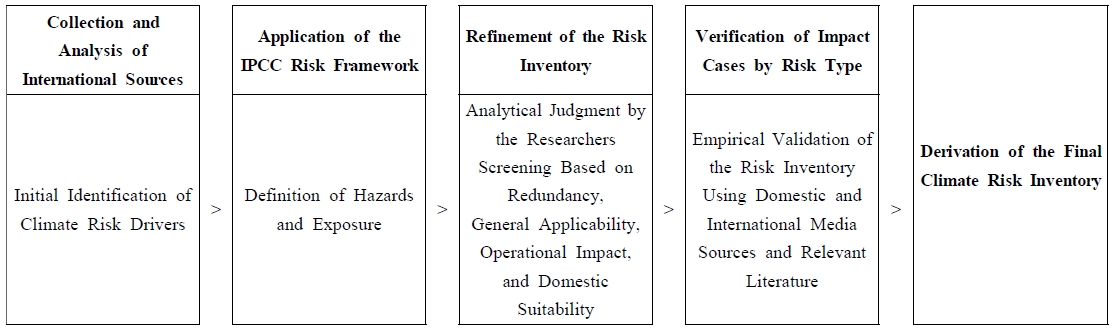
Fig. 1.

Research methods

이후, 기후리스크로 정제하는 과정에서는 연구자의 분석적 판단을 기반으로 다음과 같은 기준을 적용하였다. 첫째, 유사하거나 동일한 기후위험요소 간 중복을 제거하였다(중복성 제거). 둘째, 군종·병과·작전 유형과 관계없이 전 부대에 일반적으로 적용 가능한 위험요소를 우선 선별하였다(범용성 고려). 이는 범국방 차원에서의 적용 가능성을 고려한 것이다. 셋째, 각 기후리스크 유발요인이 군사작전의 계획, 준비, 수행, 유지 등 작전체계 전반에 미칠 수 있는 구조적 영향 가능성을 중심으로 검토하였다(작전상 필수성). 이는 각 요소가 실제로 기후리스크로 식별될 만큼 군 작전체계에 실질적이고 의미 있는 영향을 줄 수 있는지를 기준으로 선별한 것이다. 넷째, 도출된 유발요인은 국외 문헌에 기반한 것이므로, 국내 국방환경과 지형·기후 조건 등 적용 여건을 고려하여 국내 적용 가능성을 중심으로 검토하였다(국내 적합성 검토). 이는 일반적인 국내 군 운용환경과 작전 여건에 비추어 실질적인 적용 가능성이 있는지를 중심으로 판단한 것이다. 이와 같은 일련의 분석적 판단을 통해 유사하거나 중첩된 유발요인은 통합하고, 표현의 명확성과 군사적 적용성을 높이기 위해 일부 항목은 새롭게 명명하였다. 그 결과, 총 30개의 기후리스크로 구성된 국방 부문 기후리스크 목록이 도출되었다. 해당 목록의 실증적 타당성과 사례 기반의 객관성을 확보하기 위해, 국내외 언론보도 및 문헌자료를 조사하여 각 리스크별 실제 영향사례를 검토하였다. 국내 사례뿐 아니라 국외의 영향사례까지 확인함으로써, 도출된 리스크가 단순한 개념적 가능성에 그치지 않고 국내외 국방 부문에서 실제로 관측된 위협임을 검증하였다. 이를 바탕으로, 각 리스크별 실제 영향사례의 존재 여부와 그에 따른 군사적 영향을 기준으로 국내 국방환경에의 적용 가능성을 점검하여 국방 부문 기후리스크 목록을 최종 확정하였다.


4. 분석 결과

국내외 영향사례까지 확인하여 도출된 국방 부문 기후리스크는 총 30개로, 이들은 기후위험에 대한 노출성의 특성과 연계하여 다섯 개 주요 범주로 분류했다. 해당 범주는 ① 군사 시설 및 기반, ② 군사 작전 및 준비태세, ③ 군수 및 장비, ④ 병력 및 인력자원, ⑤ 국제 안보 및 지정학이다(Table 1).

Categories of climate risks in the defense sector

4.1. 군사 시설 및 기반

군사자산의 안정성과 관련된 9개의 기후리스크는 주로 군사시설의 구조적 안정성, 운용 기능의 지속성, 장기적 입지 유지 가능성에 따라 분류된다(Table 2).

Impact cases of climate risks to military facilities and infrastructure

그 중, 물리적 손상 관련 기후리스크(A-3, A-4, A-5, A-9)는 병영, 탄약고, 격납고, 통신기반시설 등 주요 군사시설이 직접적인 기상 재해에 노출되어 물리적 파손이 발생하는 유형으로, 기지 기능의 일시적 또는 지속적 마비를 초래할 수 있다. 운영 기능의 저하 및 작전성 제한 관련해서는(A-1, A-6, A-8) 활주로, 군용도로, 교통망, 상수 공급체계 등 군사 지원 인프라의 기능적 약화에 따른 위험으로, 시설의 물리적 붕괴보다는 운영 효율성과 신속 대응능력 저하에 초점이 맞춰진 기후리스크다. 군사 인프라의 장기적 운영 지속가능성 또는 입지 변경을 요구하는 기후리스크(A-2, A-7)는 연안지역 기지 및 해안 경계시설, 저지대 배치기지, 지반 약화 지역을 주요 노출 영역으로 하며, 기후변화의 누적 영향에 따라 시설의 전략적 가치 저하 및 이전·통합 필요성을 초래할 수 있는 구조적 위험 요소다. 군사시설 및 기반 범주의 기후리스크는 대부분 전 부대에 보편적으로 적용이 가능하나, A-1(활주로 과열)은 공군기지 중심, A-2(연안 침수)는 해군·해병대 기지 및 해안 경계부대, A-4(산악지역 피해)는 지형적으로 고지대 위치 산악기지에 특화된 노출 특성을 보인다.

기후리스크 영향사례로, 집중호우 등으로 지상작전사령부가 1300억원 규모의 피해를 입고(A-3), 산불로 인해 부대시설·장비 손실, 장병 대피사례(A-4)가 나타났다. 국외의 경우 하와이와 일본이 해수면 상승으로 인해 주요 기지를 이전 중인 것으로 나타났다(A-2, A-7).

4.2. 군사 작전 및 준비태세

군사 준비태세와 관련된 5개 기후리스크(Table 3)에는 기후변화로 인해 훈련·계획 수행에 변수가 발생하거나 작전의 불확실성이 증가하는 기후리스크가 해당된다(B-11, B-13). B-11은 작전계획 및 정보자산, 기상예측 체계 전반이 변화무쌍한 극한기상에 민감하게 노출되는 구조이며, B-13은 훈련장, 실외 시험시설, 야외 전술훈련 부대와 같이 현장 중심의 훈련 인프라가 주요 노출 대상이다. 이는 기상예측 정확도의 한계, 실시간 대응역량 부담 등을 통해 전투준비 태세 유지에 구조적 영향을 줄 수 있다. 군사 경계 지역의 안정성이 약화되는 유형의 기후리스크(B-10, B-12)는 군 경계선, 철책선, 감시구역, 비무장지대 일대의 지형 및 기반시설이 주요 노출 영역으로, 기후변화로 인한 지형 교란 및 토양 유실과 밀접하게 연관되며 우발 상황 발생 가능성을 높이는 요인으로 작용할 수 있다. 한편, 기후위험 대응으로 기존 전투 및 방위 임무에 투입 가능한 자원의 제약을 초래할 수 있는 기후리스크(B-14)도 식별되었다. 해당 리스크는 재난 대응·구조 임무, 민간지원 작전, 후방자원 배치체계가 주요 노출 요소로, 비전통적 임무 수행이 일상화될 경우 작전 준비 및 전투 투입 가능 자원의 분산을 초래할 수 있다.

Impact cases of climate risks to military operations and readiness

이와 같이 본 범주의 리스크들은 대부분 군종 구분 없이 전체 작전체계에 영향을 미치지만, B-10(군사경계 허점), B-12(비무장지대 인근) 기후리스크는 지리적 노출성에 따라 전방 및 경계지역 부대에서 위해성이 더 크게 나타나는 특성이 있다.

군사 작전 및 준비태세 기후리스크의 영향 사례로 군폭염위기경보 체계는 위기경보 단계를 세분화해 경계 및 지뢰제거 작전, 교육훈련, 예비군 훈련 등을 조정하고 있으며, 미국과 이스라엘에서 극한 기후현상으로 훈련을 중단한 사례가 다수 확인되었다(B-13). 이와 같이 기상이변으로 군사대비태세 유지를 위한 고유의 임무에 집중하기 어려운 실정이 지적되고 있으며, 네덜란드는 군사활동의 약 25%가 민간정부 활동 지원으로 파악하고 있고, 미국도 2022년 기준 5년간 주방위군의 화재 진압 인력 요구가 10배 이상 증가한 것으로 보고하였다(B-14).

4.3. 군수 및 장비

군수 및 장비 기후리스크는 총 6개로(Table 4), 그 중, 군수 및 병참 물류체계의 안정성에 관한 리스크(C-15)는 군수 및 보급부대, 주요 물류노선, 항공 및 육상 수송망이 기후환경에 직접적으로 노출됨에 따라, 전시 및 재난 대응 시 신속한 지원역량이 저하될 수 있다는 점에서 중요한 위협요인으로 작용한다. 극한기상 발생 빈도 증가에 따라 군수품의 비축·분산관리 부담이 가중되는 기후리스크(C-20)는 군수품 저장시설과 물자관리 체계 전반이 반복적 기상 교란에 장기적으로 노출됨을 의미한다. 장비 운용 및 유지관리 측면 기후리스크 중, C-17은 지상 전투장비 및 노출형 운용장비에 물리적 손상을 유발할 수 있으며, C-18은 해상 장비, 해상 레이더, 고주파 감시체계, 수중 음향장비 등 해양 운용 장비가 수온·염분·파랑 변화에 민감하게 반응하는 특성을 기반으로 한다. 이로 인해 전반적인 군사 장비 운용 효율이 저하되며, 정비·수리 비용 증가 등 유지관리 부담이 가중되는 기후리스크(C-16)도 식별되었다. 해당 기후리스크는 군사 장비 전반의 기후 적응성과 정비 주기 관리 체계가 직접적인 영향을 받는 구조를 보인다.

Impact cases of climate risks to logistics and equipment

무기체계 저장 안정성 저하에 관한 기후리스크(C-19)는 탄약 및 미사일을 보관하는 무기 저장시설이 온도와 화재에 민감한 특성을 갖고 있으며, 시설의 구조적 설계 기준과 관리 체계 전반에 영향을 줄 수 있는 위험 요소로 분류된다.

군수 및 장비 부문에 포함된 리스크는 전반적으로 모든 군종에 공통적으로 적용 가능한 위험을 다루지만, C-18는 해상환경 요인이 타 환경에 비해 기기 성능에 민감하게 작용한다는 점에서 해군을 중심으로 적용되는 군종 특수성을 보인다.

C-16 리스크 관련하여 폭염 시 전투기 엔진 출력 저하로 인해 기온이 가장 높은 오후 1∼3시에는 긴급발진을 제외한 이륙 제한 방침이 실행되고 있으며, 2018년에는 기록적 폭염으로 경기도 지역의 군탄약고가 폭발한 사례가 나타났으며, 독일과 그리스에서도 유사 영향사례가 확인되었다(C-19). 또한, 집중호우로 인한 울타리 전도, 토사 유실 등 군 내 부대시설의 피해도 보고되었다(C-17).

4.4. 병력 및 인력자원

군사 인력자원에 관련하여 장병의 질병 위험 증가(D-22, D-23, D-24), 극한기상 조건에서의 전투력 저하(D-21), 그리고 기후재난으로 인한 대민지원 등 비전통적 임무 확대가 병력에 미치는 영향(D-25)을 포함하며, 총 5개의 기후리스크가 식별되었다(Table 5).

Impact cases of climate risks to military personnel and human resources

장병의 질병 위험 증가는 고온·저온 등 극한기후에 직접 노출되는 야외 임무 및 실외 교육훈련 참여에 기인하며, 이는 열사병, 동상, 호흡기 질환 등 기후 관련 질환의 발생 가능성을 높인다. 또한, 훈련소, 파견부대 등 밀집 생활환경은 감염병 확산에 취약하여 기후로 인한 건강 리스크를 증대시키는 요인으로 작용한다. 기상재난의 빈도 및 강도 증가에 따른 병력의 육체적·심리적 피로도가 가중되는 리스크는 재난 대응, 구조·수색, 현장 지원 등의 임무에 반복적으로 투입되는 병력이 주요 노출 대상이며, 비정규 작전이 상시화될 경우 병력의 소진과 정신건강 저하로 이어질 수 있다.

해당 범주의 기후리스크는 전 군종에 공통적으로 적용되지만, 특히 D-21은 일반 병력 외에도 특수 장비 착용 병력과 밀폐형 기동체계 운용 병력 등 임무 환경의 물리적 부담이 높은 인력 집단에서 노출성이 더욱 크게 작용하는 특성이 있다. 국군차량은 양압장치가 부재한 경우가 높아 방독의·방독면 착용 시 고온 노출로 전투력 저하 위험이 지적되고 있으며(D-21), 2011 ~ 2021년 국내 발생 말라리아 환자 중 약 26.1%가 군복무 중 발생한 것으로 확인되었다(D-24). 미국에서도 군장병의 열사병이나 열탈진 사례가 지난 10년 동안 60% 증가하였으며 이는 군의 전투 준비태세에 연쇄적인 영향을 미치는 것으로 보고 있다(D-22).

4.5. 국제 안보 및 지정학

국제 안보 및 지정학 측면의 기후리스크는 중장기적으로 군의 전략적 역할 변화와 군사력 운용 체계 전반에 영향을 미칠 수 있는 복합적 성격으로, 총 5개의 기후리스크가 식별되었다(Table 6).

Impact cases of climate risks to international security and geopolitics

한반도 차원에서는 기후변화로 인해 북한의 기후 취약성이 심화되고 내부 사회·경제적 불안정성이 가중되어 군사적 긴장이 높아질 수 있는 위험(E-26)이 식별되었다. 이는 특히 전방 및 접경지역, 전략기획 부대를 중심으로 안보 환경의 불확실성을 증대시킬 수 있는 지정학적 위협이다. 기후변화로 인한 자원 부족 및 확보 경쟁 심화 가능성(E-27)은 군수품, 에너지 등 전략 물자의 확보 체계뿐 아니라 국가 재난대응 작전자원과도 밀접하게 연계된다.

해양 영역에서는 북극 해빙지대 감소 등으로 인해 글로벌 해양 접근성 및 항로 이용이 확대되며, 해상 주도권 경쟁이 격화되는 위험(E-28)이 나타났다. 이는 극지해역 감시작전, 해상경계 임무, 해군 전략 재배치 등에 직결되는 리스크로 해양전략 재정비가 요구된다.

해외 파병 및 국제 평화유지 활동 지역에서 기후변화로 인한 극한기상에 직면할 경우, 낯선 기후환경에 대한 적응 부담이 증가하고 작전 수행 여건이 악화되어 임무 수행 난이도가 높아지는 기후리스크(E-29)도 도출되었다. 이는 열대, 사막, 극지 등 기후 조건이 국내와 상이한 지역에서 활동하는 파병 부대 및 해외 기지를 주요 노출대상으로 하며, 기존 대비태세로는 충분히 대응하기 어려운 새로운 작전환경이 전개될 수 있다는 점에서 의미 있는 위협요소로 볼 수 있다.

마지막으로, 기후위기에 대한 대응 요구가 높아짐에 따라 군이 기존 방위 임무 외에도 재난 대응, 인도주의 작전 등 다양한 임무를 병행하게 되고, 이에 따라 자원과 인력의 우선순위가 재조정되는 위험(E-30)이 식별되었다. 이는 작전계획, 부대 편성, 인력·장비 배분 체계 전반에 영향을 미치며, 군의 정체성과 역할 재정립까지 포함하는 근본적인 구조 변화로 이어질 수 있다.

E-26 리스크 관련하여 기후변화로 인해 북한의 식량난 심화 등은 기후난민 발생과 테러·안보 불안 요인으로 작용하고, 임진강 등 남북한 수자원 관리 분쟁 가능성이 제기되고 있다. 국제적으로도 기후변화로 인한 재해 및 전쟁이 인구이동으로 이어져 국가 간 대립이 고조되는 현상을 지적하고 있다(E-27). E-30 기후리스크는 최근 5년간 재난 대응 및 피해 복구를 위해 장병 약 269만여 명과 장비 17만 1천여 대 지원에서 확인된다. 미국도 기후재난 심화로 해외 갈등 대응과 국내 재난 지원 사이 자원 배치 갈등 심화를 예상하는 것으로 나타났다.


5. 결론

5.1. 연구결과 요약

독립적으로 수립된 국방부 계획이나 전략을 활용하여 도출한 기후리스크 유발요인에 IPCC 리스크 프레임워크를 적용하고, 이를 기반으로 영향사례를 검증해 국내 국방 부문에 적용가능한 총 30개의 기후리스크를 식별했다. 5개 범주로 구분된 국방 부문 기후리스크의 주요 특징은 다음과 같다. 첫째, 군사 시설 및 기반 부문의 기후리스크 9개는 극한현상으로 인한 기지·인프라 피해에 초점을 두고 있으며, 인프라 유지·보수 및 배치 전략의 필요성을 보여준다. 해당 부문에는 해수면 상승, 지반 약화, 용수 부족 등 장기적 입지 변화에 관련한 기후리스크도 포함한다. 둘째, 군사 작전 및 준비태세 부문 기후리스크 5개는 작전 조건의 불확실성이 증대되거나 작전 수행 역량이 저하되는 상황 리스크가 식별되었다. 특히, DMZ 지뢰 유실 같은 한국의 특수성이 반영된 리스크가 식별된 특징도 있다. 기후재난으로 인한 군사작전이나 준비태세의 문제뿐 아니라 기후재난 대응 임무 증가로 본래 방위 임무 여력 약화 가능성도 지적된 특징이 있다. 셋째, ‘군수 및 장비’ 부문은 이상기후로 인한 군수 보급체계의 물리적 단절, 물자 수송의 지연 및 공급 불안정성의 확대와 관련된 리스크를 포함한다. 또한, 기후요인으로 인해 장비 성능이 저하되거나 정비 주기 및 유지관리 비용이 증가하는 위험이 포함되며, 총 6개의 기후리스크가 이 범주에 속한다. 넷째, 병력 및 인적자원 부문의 기후리스크는 폭염·한파로 인한 온열질환·한랭질환, 감염병 증가 등 건강 리스크 중심으로 총 5개의 기후리스크가 식별되었다. 대민지원 증가로 인한 병력의 체력·심리적 피로 누적이 특징으로 나타났으며, 병력 건강관리와 인력 유지 문제를 군 대비태세의 핵심으로 제시한다. 마지막으로 국제 안보 및 지정학 부문의 총 5개의 리스크는 북한 기후취약성(식량난·수자원 부족)이 한반도 안보 불안으로 이어지는 위험, 자원 부족·해수면 상승이 국가 간 분쟁 위험으로 이어지는 위험이 식별되었다. 그리고 북극 해빙·항로 경쟁, 파병 지역의 기후재난이 군사 자원 재배치와 전략 우선순위 변화로 이어지는 기후리스크도 식별됐다.

5.2. 본 연구의 의의 및 향후과제

본 연구는 방법론적, 정책적, 국제적 측면에서 의의가 있다. 먼저 방법론 측면에서 IPCC 리스크 프레임워크를 국방 분야에 최초로 적용하여 체계적·정량적 분석 기반을 마련했으며, 국내외 실제 영향사례를 검토함으로써 단순 이론적 식별을 넘어 실증적 근거 기반의 목록으로 발전시킨 점에서 의의가 있다. 두 번째로 구체적 기후위험을 국방 맥락에서 식별·체계화함으로써, 향후 국방 기후적응 전략 마련에 활용 가능한 체크리스트 및 의사결정 도구 제공했다는 점에서 정책적 활용성 측면의 의의가 있다. 기후리스크는 향후 부대 시설관리, 훈련·작전계획, 군수·인력 관리 등에서 실무와 정책 간 연계성을 강화하여 국방 부문의 기후적응 내재화에 기여할 것이다. 마지막으로 본 기후리스크는 미군·NATO 사례와 연계되어 향후 국제 협력·연합 작전 차원에서 의사결정에 활용이 가능하다. 이는 동맹국과의 정보 공유·정책 협력에도 기여할 수 있어, 국제적 기후안보 담론에 연결점을 제공하는 국제적 활용성 측면에서 의의가 있다.

본 연구에서는 기후리스크별 국내외 영향 사례를 식별하였다. 다만 국방 부문에서의 기후변화 영향 사례는 군사력과 직결되는 특성상 대부분 기밀·보안 사항으로 관리되어 외부 자료를 통해 확인 가능한 영향 사례에는 구조적인 한계가 존재한다. 기후위험과 실제 영향 사례에 대한 정확한 파악을 전제로 하는 기후리스크 관리는 군 내부의 실증자료에 기반할 때 가장 효과적으로 이루어질 수 있다. 따라서 향후에는 군종별 기후 피해, 장비 손상, 작전 및 훈련 차질 등에 대한 실증자료를 체계적으로 축적·활용함으로써, 본 연구에서 도출된 기후리스크 목록이 국방 분야 기후위험 관리의 기반 자료로 활용되고 실효적이고 지속가능한 대응체계로 이어질 수 있을 것이다.

Acknowledgments

이 연구는 한국환경연구원에서 기후에너지환경부의 수탁과제로 수행된 「국가 기후위기 적응대책 수립 및 주류화 지원(2025-001-01)」의 지원으로 작성되었습니다.

Notes

2) 미 육군 공병단(USACE)이 육군 설치·에너지·환경 차관보실을 위해 기존 지리공간 도구를 기반으로 개발한 도구로 국방부 기지가 가장 많이 노출되는 기후위험(연안홍수, 하천 홍수, 폭염, 가뭄, 에너지 수요, 토지 황폐화, 산불, 과거 극한기상 사건)을 식별하는 데 활용(Pinson et al., 2021).

References

  • Department of Defense (DOD). 2024. Department of defense climate adaptation plan 2024–2027. Washington, DC: U.S. Department of Defense.
  • Department of the Air Force. 2023. Department of the Air Force climate campaign plan. Washington, DC: U.S. Department of the Air Force.
  • Department of the Navy. 2022. Department of the Navy climate action 2030. Washington, DC: U.S. Department of the Navy.
  • Future Strategy Research Committee. 2024. 2024 outlook and challenges for the defense policy environment. Seoul: Korea Institute for Defense Analyses.
  • IPCC. 2019. IPCC special report on the ocean and cryosphere in a changing climate. Geneva: Intergovernmental Panel on Climate Change.
  • Joint Interministerial Task Force. 2018. Detailed implementation plan for the second national climate change adaptation plan (2016–2020). Sejong, Republic of Korea.
  • Jung WS, Lee JJ, Pyun YB. 2022. Impacts of sea-level rise caused by climate change on naval military facilities in coastal cities (in Korean with English abstract). Korea Soc Nav Sci Technol 5(2): 174-179. [https://doi.org/10.31818/JKNST.2022.09.5.2.147]
  • Lee NS. 2024. Climate change and combat readiness: Responses of advanced countries and policy implications. Defense Forum 1993; [accessed 2026 Feb 9]. https://www.kida.re.kr/frt/board/frtNormalBoardDetail.do?searchCondition=title&searchKeyword=&pageIndex=1&depth=3&sidx=382&idx=2057&stype=&v_sidx=&lang=kr
  • Ministry of Defence. 2021. Ministry of Defence climate change and sustainability strategic approach. London: UK Ministry of Defence.
  • Ministry of National Defense. 2025. Materials submitted to the office of National Assembly Member Kang Dae-sik. July 28, 2025.
  • Ministry of the Interior and Safety. 2025. Launch of an all-out response posture for summer natural disasters. Press release, May 14, 2025.
  • NATO. 2024. NATO climate change and security impact assessment: Third edition. Brussels: North Atlantic Treaty Organization.
  • Pinson AO, White KD, Ritchie EE, Conners HM, Arnold JR. 2021. DoD installation exposure to climate change at home and abroad. Washington, DC: U.S. Army Corps of Engineers.
  • U.S. Army. 2022. United States Army climate strategy. Washington, DC: Department of the Army.

Appendix

부록

Impact case data by climate risk

Fig. 1.

Fig. 1.
Research methods

Table 1.

Categories of climate risks in the defense sector

Category Description No. of Risks
① Military Facilities and Infrastructure ⦁Structural damage to military facilities and degradation of functional performance
⦁Reduced capacity for continuous operation and maintenance of critical infrastructure
9
② Military Operations and Readiness ⦁Increased uncertainty in operational conditions
⦁Degradation of operational capability
5
③ Logistics and Equipment ⦁Decline in equipment performance and increased maintenance burden
⦁Physical disruption of logistics supply chains and heightened supply instability
6
④ Personnel and Human Resources ⦁Constraints on troop training and weakening of combat effectiveness
⦁Increased physical and psychological threats to service members’ health, safety, and working conditions
5
⑤ International Security and Geopolitics ⦁Heightened geopolitical instability and escalation of regional tensions
⦁Increased potential for changes in international military cooperation frameworks and military roles
5

Table 2.

Impact cases of climate risks to military facilities and infrastructure

No. Risk Domestic Impact Cases International Impact Cases
Source: See Appendix 1
A-1 Runway overheating and degradation of aircraft operational performance due to increased frequency and intensity of heatwaves ⦁Reduced air density under high temperatures decreases aircraft engine thrust and lift, requiring longer takeoff distances and higher speeds, thereby reducing operational safety.1 ⦁In the United Kingdom, temperatures in some areas reportedly approached 100°F, leading to runway-related issues at London Luton Airport and RAF Brize Norton.2
A-2 Increased risk of flooding and inundation of coastal military bases due to sea-level rise and storm surges ⦁Under the RCP8.5 scenario, two naval bases (Mokpo and Jeju) are projected to become inoperable by around 2100 due to sea-level rise.3 ⦁During a Category 4 storm, approximately 80% of Naval Station Norfolk in the United States is projected to be exposed to flooding, increasing to 95% by 2100, which is expected to severely degrade operational capability and core mission functions.4
A-3 Increased risk of damage to military facilities due to floods, typhoons, and heavy snowfall ⦁Heavy rainfall and typhoons caused approximately KRW 130billion in damage to the Ground Operations Command, including the collapse of about 16 km of fencing, damage to approximately 50km of advanced surveillance systems, and seven cases of facility collapse.5 ⦁Flooding inundated Offutt Air Force Base in the United States (2019).6
⦁Hurricane Michael destroyed Tyndall Air Force Base, one of the largest F-22 bases in the United States, damaging numerous aircraft.7
A-4 Increased risk of damage to military facilities in mountainous areas due to wildfires and landslides ⦁Wildfires in Gangwon Province resulted in partial loss of buildings and equipment at nearby Army units (2019).8
⦁Large-scale wildfires in the Gyeongsang region caused damage to nearby military bases and required the evacuation of service members (2025).9
⦁The 2020 California “Gigafire” wildfire caused damage to nearby U.S. military installations.10
A-5 Increased risk of flooding of military facilities due to intensified typhoons and heavy rainfall ⦁Heavy rainfall in the Yanggu area caused flooding of military facilities, with total damages estimated at KRW 11.6billion (2020).11
⦁Flooding of the Gwangju Airport runway led to the cancellation of 12 flights (2020).12
⦁The U.S. Army’s Roi-Namur installation experienced flooding of multiple buildings, including dining and maintenance facilities, as well as runways, due to storm surges and typhoons.13
⦁Typhoon Mawar struck Guam in 2023, flooding airport terminals, power systems, and pumping facilities.14
A-6 Reduced mobility due to restricted use of key transportation infrastructure, such as roads and runways, caused by extreme weather events ⦁Structural constraints within Air Force bases, such as covered drainage sections and narrow bridge structures, have caused delayed drainage and increased flood risk during heavy rainfall events.15 ⦁Storm-induced flooding at Scott Air Force Base overwhelmed existing drainage systems, leading to infrastructure failures.16
⦁Flooding at U.S. Army installations in Italy resulted in road closures.17
⦁Runway melting at Royal Air Force bases in the United Kingdom led to the suspension of aircraft takeoffs and landings.18
A-7 Increased need for relocation of military bases due to changes in site suitability caused by sea-level rise and ground instability ⦁Under the RCP8.5 scenario by 2100, two of seven major naval facilities (Mokpo and Jeju) are projected to become inoperable, while two others (Jinhae and Donghae) are expected to experience partial inundation, with all port and pier facilities submerged.3 ⦁A military base in Hawaii relocated a pistol shooting range approximately 40 meters inland.19
⦁Japan plans to construct underground command facilities and relocate and consolidate major bases and camps by fiscal year 2027.19
A-8 Constraints on securing water supply for military bases due to drought ⦁Yongin City implemented the construction of water reuse (greywater) facilities at the Ground Operations Command to enhance preparedness for emergency situations such as water shortages.20 ⦁The U.S. Government Accountability Office (GAO) reported that more than 100 military bases face water scarcity risks.21
A-9 Damage to surveillance and communication systems, power outages, and restricted access to remote bases due to heavy rainfall and lightning ⦁Post-disaster recovery has progressed slowly, with recovery rates as low as 3.4% for surveillance systems, and delays in restoring damaged cables and collapsed facilities.22 ⦁In Kuwait, flooding of underground communication lines at Camp Buehring disrupted facility communication functions.23

Table 3.

Impact cases of climate risks to military operations and readiness

No. Risk Domestic Impact Cases International Impact Cases
Source: See Appendix 1
B-10 Increased security vulnerabilities in guarded areas due to heavy rainfall ⦁GOP border fences are repeatedly overturned or washed away each year by heavy rainfall and typhoons; in 2021, heavy rainfall caused fence collapse over sections approximately 30 times larger than in 2019.24 ⦁An analysis of 654 U.S. military installations found that, when buffer zones were included, risk levels increased at 42 facilities; at 35 facilities, core installations remained safe, but surrounding infrastructure was at risk, revealing vulnerabilities in perimeter security, access routes, and connections to public services.25
B-11 Increased uncertainty in military operations and planning due to extreme weather events ⦁GOP border fences are repeatedly overturned or washed away each year by heavy rainfall and typhoons; in 2021, heavy rainfall caused fence collapse over sections approximately 30 times larger than in 2019.24 ⦁In the United States, extreme weather events have repeatedly disrupted military readiness over the past decade, resulting in recovery costs amounting to several billion dollars.27
B-12 Increased displacement of landmines in the Demilitarized Zone due to heavy rainfall ⦁Mine-laying activities have been identified along inter-Korean shared rivers, including the Imjin River, Yeokgok Stream, Hwagang River, and Inbuk Stream, raising concerns that heavy rainfall may lead to landmine displacement and inflow.²⁸
⦁During periods of heavy rainfall between August and September 2020, a total of 259 North Korean landmines were discovered.29
⦁Flooding in the Diyala region of Iraq led to the discovery of landmines and other explosive remnants of war, while floods in Bosnia in 2014 displaced thousands of landmines laid during the 1992–1995 conflict.30
⦁Heavy rainfall reduces accessibility and constrains demining operations by limiting the use of machinery and mine-detection dogs under wet conditions.31
B-13 Increased likelihood of suspension, delay, or cancellation of outdoor training and testing due to extreme weather ⦁The military heatwave alert system classifies risk levels into Attention, Caution, Alert, and Severe, and adjusts surveillance, demining operations, education and training, and reserve force exercises accordingly.32 ⦁In Israel, extreme heat led to the suspension of all ground training by the Israel Defense Forces.33
⦁In the United States, storms required adjustments to training schedules for the 82nd Airborne Division, underscoring the importance of training flexibility.34
B-14 Increased military burden from climate disasters and humanitarian operations, weakening defense readiness ⦁As the frequency of extreme weather events increases, the need for military support to civilian authorities is expected to grow, highlighting the importance of operational concepts that balance flexibility and established principles.35
⦁Climate-related extreme events make it increasingly difficult for the military to focus on its core missions required to maintain defense readiness.36
⦁In the Netherlands, the Middendorp military unit allocates approximately 25% of its activities to supporting civilian government functions, including the protection of flood defense systems.37
⦁In the United States, demand for National Guard firefighting personnel increased more than tenfold over a five-year period as of 2022, with a corresponding rise in the deployment of military aircraft for firefighting operations.38

Table 4.

Impact cases of climate risks to logistics and equipment

No. Risk Domestic Impact Cases International Impact Cases
Source: See Appendix 1
C-15 Potential disruption or delay of military operations and logistics supply chains due to climate change - ⦁NATO has highlighted the potential for floods, snow/ice, and storms to block operational supply routes, as well as the vulnerability of transport corridors that rely on coastal roads.39
C-16 Increased maintenance and repair costs and reduced operational efficiency of equipment due to extreme weather events(e.g., heatwaves and cold waves) ⦁During heatwaves, reduced fighter aircraft engine thrust has led to restrictions on takeoffs between 1:00 and 3:00 p.m.—the hottest period of the day—except for emergency sorties.40
⦁Surface combatants deployed in modern warfare are equipped with high-value electronic systems, which are more susceptible to malfunction when exposed to high temperatures.40
⦁Sea-level rise and heatwaves threaten the structural integrity of military facilities, increasing the likelihood of equipment failure due to flooding or overheating and causing operational disruptions.41
C-17 Increased risk of equipment flooding and corrosion damage due to heavy rainfall ⦁The Ministry of National Defense reported damage at 32 military installations due to heavy rainfall, including fence collapse, soil erosion, and facility flooding.42
⦁In late July 2024, barracks, tool storage facilities, ammunition depots, and armories at a battalion-level unit in Taechon County, North Korea, were inundated by flooding.43
⦁According to the 2021 U.S. Department of Defense Corrosion Prevention and Control Strategy, corrosion maintenance and repair cost the U.S. Navy approximately USD 7 billion annually, resulting in an estimated 11 million hours of maintenance time and losses in flight hours.44
C-18 Degradation and increased corrosion risk of sensors, precision equipment, and maritime assets due to changes in meteorological and oceanographic conditions (e.g., wave height, rising sea temperature and salinity) ⦁Rising sea temperatures, stronger winds, and increased frequency and intensity of typhoons associated with climate change can increase salt spray, thereby accelerating corrosion rates.45 ⦁Coastal erosion affecting U.S. Air Force early-warning radar and communication facilities has increased (2014), and the Center for Climate and Security reported performance degradation in aircraft as temperatures and humidity rise.46
⦁Research by the NATO Defense College and ETH Zurich projects that climate-induced changes in ocean salinity associated with global warming will make submarine detection increasingly difficult.47
C-19 Reduced storage stability of weapon systems (e.g., ammunition and missiles) due to heatwaves and wildfires ⦁In 2018, a military ammunition depot (Bakdal-dong, Anyang, Gyeonggi Province) exploded during a record-breaking heatwave; conventional above-ground ammunition storage facilities are particularly vulnerable to extreme heat, highlighting the need for igloo-type or underground storage facilities.48 ⦁In Germany (2022), an explosion at a police ammunition storage facility in the Grunewald forest triggered a large-scale wildfire.49
⦁In Greece, prolonged wildfires driven by record-breaking heatwaves caused a major explosion at an Air Force ammunition depot.50
C-20 Increased burden of stockpiling and distributed management of military supplies due to the growing frequency of extreme weather events - ⦁Severe droughts or floods in conflict zones can damage water supply chains, increase the risk of water diversion, and place additional strain on humanitarian assistance and disaster relief (HADR) capacities as the frequency and intensity of natural disasters rise.51

Table 5.

Impact cases of climate risks to military personnel and human resources

No. Risk Domestic Impact Cases International Impact Cases
Source: See Appendix 1
D-21 Increased operational fatigue and reduced combat endurance under extreme environmental conditions, such as heatwaves, heavy rainfall, and cold waves ⦁Many vehicles in the Republic of Korea Armed Forces are not yet equipped with positive-pressure systems; as a result, wearing protective suits and gas masks under high-temperature conditions increases heat exposure and poses a risk of reduced combat effectiveness.52 ⦁During the 2003 U.S. deployment to Iraq, approximately 5% of deployed personnel experienced heat-related injuries and functional impairment; in the United Kingdom, heat-related injuries accounted for about 15% of all military hospital admissions, with more than 800 heat-related casualties reported.53
D-22 Increased risk of heat-related illnesses among service members due to more frequent heatwaves and tropical nights ⦁The number of medical consultations at military medical facilities for heat-related illnesses has increased steadily, from 812 cases in 2020 to 991 in 2021, 1,124 in 2022, and 1,383 in 2023.54 ⦁Cases of heat stroke and heat exhaustion in the U.S. military increased by approximately 60% over the past decade, with cascading effects on military combat readiness.55
D-23 Increased risk of cold-related illnesses among service members due to extreme cold events ⦁Frostbite cases are primarily attributable to winter training, field exercises, duty assignments, and snow removal operations, accounting for 94% of incidents; more than half of affected personnel did not receive specialized medical treatment within seven days (as of 2016).56 ⦁When finger temperatures drop below approximately 15°C, weapon handling performance is adversely affected.57
⦁Cold-related injuries tend to be underreported, underscoring the importance of monitoring by military commanders and medical personnel.58
D-24 Increased exposure of service members to infectious and vector-borne diseases due to climate change ⦁Among domestically reported malaria cases between 2011 and 2021, approximately 26.1% occurred during military service.59 ⦁Malaria remains a significant infectious disease threat to U.S. forces deployed in tropical and subtropical regions.60
D-25 Increased demand for military support to civilian authorities due to more frequent and intense weather disasters, leading to greater physical and psychological fatigue among personnel ⦁Since 2005, more than 100,000 personnel have been deployed annually for disaster recovery operations; however, working conditions remain poor due to equipment shortages, and measures to ensure the safety and health of troops engaged in civil support for disaster recovery are insufficient.61 ⦁Deployments for natural disaster response inherently involve a high risk of psychological trauma, with elevated risks of post-traumatic stress disorder (PTSD).62

Table 6.

Impact cases of climate risks to international security and geopolitics

No. Risk Domestic Impact Cases International Impact Cases
Source: See Appendix 1
E-26 Heightened security instability on the Korean Peninsula due to climate change–driven food insecurity, water scarcity, and public health crises in North Korea ⦁Climate change–driven food insecurity has contributed to the emergence of climate refugees, increasing the risk of terrorism and broader security instability.63
⦁There is a potential for inter-Korean disputes over transboundary water resource management, including the Imjin River.64
-
E-27 Increased risk of interstate conflicts and disputes arising from climate change–induced resource scarcity and sea-level rise ⦁Climate-induced resource scarcity may lead to population displacement, thereby increasing the risk of conflict and violent confrontation.65 ⦁Climate change–induced disasters and armed conflicts can trigger population displacement, which in turn may intensify interstate tensions and confrontations.66
E-28 Intensified geopolitical competition and heightened military tensions over new shipping routes and resource development due to the reduction of Arctic sea ice ⦁The reduction of Arctic sea ice has intensified competition over new shipping routes and resource development, heightening military tensions and underscoring the need to strengthen the response capabilities of the Republic of Korea Armed Forces.66 ⦁Russia has expanded its military presence in the Arctic, while China has asserted its interests as a “near-Arctic state” through the establishment of research stations and operational activities; in response, the United States, Canada, and Finland have formed cooperative efforts, including the Icebreaker Collaboration Effort (ICE Pact), to counter growing Russian and Chinese influence, reflecting intensified geopolitical competition in the Arctic.67
E-29 Deterioration of operational environments and increased mission complexity in overseas deployments and international peacekeeping operations due to extreme weather ⦁During climate-related response missions, the Evergreen Unit deployed to Timor-Leste faced poor infrastructure and severe weather conditions, resulting in a fatal accident.68 ⦁To prevent damage from seasonal flooding, the United Nations Mission in South Sudan (UNMISS) has integrated seasonal climate forecasts into its military assessment and planning processes.
⦁In Mozambique, the lack of strategic airlift capacity during the rainy season has constrained the operational scope of deployed forces, including the Southern African Mission in Mozambique (SAMIM).69
E-30 Shifts in military priorities due to increased disaster response missions and the reallocation of military resources driven by climate change ⦁Over the past five years, the Republic of Korea Armed Forces have supported disaster response and recovery operations by deploying approximately 2.69 million personnel and 171,000 units of equipment.70 ⦁According to U.S. MiRCH data, since 2022 military forces have been deployed in 176 disaster response operations; as climate-related disasters intensify, competition over resource allocation between overseas conflict response and domestic disaster assistance is expected to increase.71

Appendix 1.

Impact case data by climate risk

Risk References
A-1 1) https://www.airportal.go.kr/news/eventNewsDetail.do?num=101135
2) https://www.axios.com/2022/07/19/airport-runways-melting-heat
A-2 3) Jung WS, Lee JJ, Pyun YB. 2022. Impacts of sea-level rise caused by climate change on naval military facilities in coastal cities. Korea Society for Naval Science and Technology 5(2): 174-179. doi: 10.31818/JKNST.2022.09.5.2.147
4) ASP. 2022. 2021–2022 U.S. Defense Climate Highlights and Case Studies.
A-3 5) https://kpinews.kr/newsView/179546674447973
6) https://climateandsecurity.org/2020/05/lack-of-flood-maps-at-many-u-s-military-bases-creates-risks/
7) https://www.axios.com/2019/03/28/air-force-bases-billions-extreme-weather-climate-change
A-4 8) https://www.yna.co.kr/view/AKR20190405156800503
9) https://www.yna.co.kr/view/AKR20250327141900504
10) https://www.newspenguin.com/news/articleView.html?idxno=4739
A-5 11) https://kwnews.co.kr/page/view/2020080900000000065
12) https://www.newsis.com/view/NISX20200808_0001123137
13) https://www.foxweather.com/extreme-weather/video-rouge-waves-us-military-roi-namur-marshall-islands
14) https://www.airforcetimes.com/news/your-air-force/2023/09/01/recovery-takes-shape-at-air-forces-typhoon-battered-base-in-guam/
A-6 15) https://m.kwnews.co.kr/page/view/2020090700000000083
16) https://www.scott.af.mil/News/Article/3844404/scott-afb-responds-to-flash-flooding/
17) https://www.stripes.com/theaters/europe/2024-02-28/school-closure-caserma-ederle-vicenza-13145607.html
18) https://fortune.com/europe/2022/07/18/how-bad-is-uk-heat-wave-royal-air-force-melted-runway-heatrow-luton-brize-norton/
A-7 3) Jung WS, Lee JJ, Pyun YB. 2022. Impacts of sea-level rise caused by climate change on naval military facilities in coastal cities. Korea Society for Naval Science and Technology 5(2): 174-179. doi: 10.31818/JKNST.2022.09.5.2.147
19) https://ipdefenseforum.com/ko/2023/12/%EB%B3%B5%EC%9B%90%EB%A0%A5-%EA%B5%AC%EC%B6%95-2/
A-8 20) https://www.kgnews.co.kr/news/article.html?no=753368
21) https://www.military.com/daily-news/2019/12/02/more-100-military-bases-now-risk-water-shortages-gao-finds.html
A-9 22) https://kpinews.kr/newsView/179546674447973
23) https://www.army.mil/article/214599/soldiers_repair_flood_damage_across_kuwait?
B-10 24) https://www.segye.com/newsView/20211013506089
25) https://www.linkedin.com/pulse/military-installations-risk-analyzing-flood-us-defense-ryan-kmetz-qqpie?
B-11 24) https://www.segye.com/newsView/20211013506089
27) Department of Defense (DoD). 2024. Climate Adaptation Plan 2024–2027.
B-12 28) https://www.chosun.com/politics/diplomacy-defense/2024/07/17/JUN3HK4UE5GZNAEUYRDRMORT3M/
29) https://www.asiae.co.kr/realtime/sokbo_viewNew.htm?idxno=2020102209054346435
30) https://floodlist.com/asia/iraq-floods-increase-landmine-threat-diyala?
31) https://ceobs.org/landmines-and-the-environment-can-we-do-better/
B-13 32) https://www.hankyung.com/article/2018080516547
33) https://www.jns.org/israeli-military-cancels-ground-forces-drills-amid-oppressive-heat-wave/
34) https://abc7ny.com/west-point-flooding-army-us-military/13485898/
B-14 35) https://news.mt.co.kr/mtview.php?no=2023081914554083868
36) http://hankookilbo.com/News/Read/A2021120210490005768
37) https://ipdefenseforum.com/ko/2019/03/%EA%B8%B0%ED%9B%84-%EB%B3%80%ED%99%94%EC%97%90-%EB%8C%80%ED%95%9C-%EB%8C%80%EC%9D%91-%EC%A0%88%EC%8B%A4/
38) https://www.atlanticcouncil.org/content-series/reality-check/reality-check-13-great-power-competition-threatens-climate-disaster-response/
C-15 39) https://www.nato.int/docu/review/articles/2021/04/01/nato-is-responding-to-new-challenges-posed-by-climate-change/index.html
C-16 40) https://www.khan.co.kr/article/201808051346001
41) Larsen P, et al. 2024. Weather effects on the lifecycle of U.S. Department of Defense equipment replacement. Building and Environment 259. doi: 10.1016/j.buildenv.2024.111639
C-17 42) https://news.kbs.co.kr/news/pc/view/view.do?ncd=5530577
43) https://www.dailynk.com/20241205-5/
44) https://dsiac.dtic.mil/articles/atmospheric-corrosion-severity-and-the-role-of-the-environment-determining-a-direct-correlation/
C-18 45) Oh KW, Lim SH. 2017. Corrosion of the Gas-Turbine Engine According to the Environment of the Korean Seas. Journal of Aerospace System Engineering, 11(2), 43-50. doi: 10.20910/JASE.2017.11.2.43
46) https://climateandsecurity.org/wp-content/uploads/2019/08/climate-change-implications-for-us-military-aircraft_briefer-44.pdf
47) https://www.economist.com/science-and-technology/2025/03/27/climate-change-may-make-it-harder-to-spot-submarines
C-19 48) https://www.chosun.com/site/data/html_dir/2018/08/08/2018080800097.html
49) https://www.nfa.go.kr/nfa/news/disasterNews/;jsessionid=7Wi-1lddVhq2-VKsNeHrol8D.nfa12?boardId=bbs_0000000000001896&mode=view&cntId=157596&category=&pageIdx=5126
50) https://www.mt.co.kr/world/2023/07/29/2023072910435284398
C-20 51) https://climatesecurity101.org/faqs/why-do-militaries-care-about-climate-change/
D-21 52) https://www.sedaily.com/NewsView/1S37V5JAN4
53) https://orientxxi.info/magazine/us-military-destabilised-by-climate-change-in-the-middle-east,4885
D-22 54) https://www.seoul.co.kr/news/society/2024/06/12/20240612001006
55) https://insideclimatenews.org/news/23122019/military-climate-change-unprepared-national-security-conflict-heat-risk-war-college-2019-year-review/
D-23 56) https://www.intn.co.kr/news/articleView.html?idxno=558131
57) https://link.springer.com/rwe/10.1007/978-3-030-02866-4_107-1
58) Sullivan-Kwantes et al. (2017) Medical Encounters During a Joint Canadian/U.S. Exercise in the High Arctic (Exercise Arctic Ram). Military Medicine, Volume 182, Issue 9-10, September 2017, Pages e1764–e1768. doi: 10.7205/MILMED-D-16-00390
D-24 59) https://parasitol.or.kr/journal/view.php?number=1553
60) https://pmc.ncbi.nlm.nih.gov/articles/PMC11189824/
D-25 61) Ministry of National Defense. 2017. Performance management strategic plan 2017–2021.
62) EEin, N., Plouffe, R.A., Liu, J.J.W. et al. Physical and psychological challenges faced by military, medical and public safety personnel relief workers supporting natural disaster operations: a systematic review. Curr Psychol 43, 1743-1758). doi: 10.1007/s12144-023-04368-9
E-26 63) Kim HH, Kim IK. 2020. New security policy in the Kim Jong-un era and directions for inter-Korean cooperation. INSS Research Report 2020-7.
64) Inter-Korean Exchange and Cooperation Support Association. 2024. International responses to climate change and the climate crisis on the Korean Peninsula.
E-27 65) Shim KW, Park SH, Noh IK. 2012. Climate change and Korea’s response from a national security perspective. Seoul: Korea Institute for Defense Analyses.
66) U.S. DoD. 2003. An abrupt climate change scenario and its implications for United States national security.
E-28 65) Shim KW, Park SH, Noh IK. 2012. Climate change and Korea’s response from a national security perspective. Seoul: Korea Institute for Defense Analyses.
67) https://www.ynetnews.com/article/skwilhio0
E-29 68) Yang CH, Lee SC. 2014. A study on success factors of Korea’s international peacekeeping policy. Journal of Police Policy Studies 28(2): 291-321. doi: 10.35147/knpsi.2014.28.2.291
69) https://www.accord.org.za/analysis/responding-to-climate-change-in-african-peace-operations-from-risk-to-resilience
E-30 70) Yang DS. 2025. A study on improvement measures for military support to civil authorities. Master’s thesis, Graduate School of Public Administration, Hansung University.
71) https://councilonstrategicrisks.org/2025/02/12/mirch-update-military-responses-to-climate-disasters-across-the-united-states/